
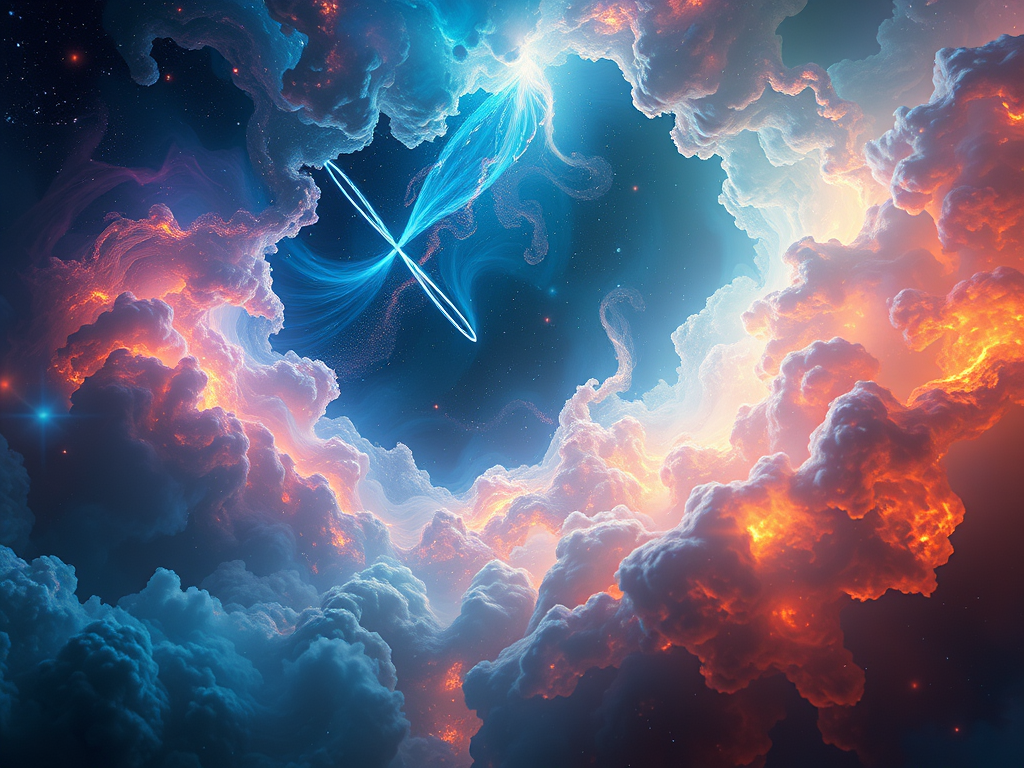
Event: Recombination and Decoupling
Date: ~380,000 years after the Big Bang
“Light could finally walk alone.”
-George Smoot
Dear Human,
The universe was still young, but no longer wild.
For hundreds of thousands of years after the Big Bang, everything was a fog. The cosmos was filled with a dense plasma—hot, opaque, and chaotic. Light existed, but it couldn’t move freely. Every photon was trapped, constantly scattered by free electrons in a storm of charged particles. It was a glowing soup, brilliant but blind.
Then came the quiet.
As the universe expanded, it continued to cool. Around 380,000 years after the beginning, the temperature dropped enough for something extraordinary to happen. Free electrons and protons began to combine and form stable atoms, mostly hydrogen. This process is called recombination—not because it had happened before, but because matter was finally calming down enough for particles to come together and stay together.
What is an atom, after all? It is a tiny system, held together by invisible forces. At its heart lies a nucleus—a dense core made of two kinds of particles: protons, which carry a positive electrical charge, and neutrons, which are neutral and carry no charge at all. Together, they give the atom its mass and identity.
Orbiting this center, like moons around a planet, are electrons—tiny, negatively charged particles. They are much lighter than protons or neutrons, yet they define how an atom behaves, especially how it connects with others. Electrons are held in place by the electromagnetic force, constantly in motion, but bound by the nucleus’s pull.
Though mostly empty space, atoms are the building blocks of all matter. And hydrogen—the simplest atom—has just one proton and one electron. Its simplicity made it the first.
But atoms are not only solitary. They are drawn to one another, shaped by need and balance. Their outer electrons seek harmony—sometimes shared, sometimes surrendered, sometimes stolen. These interactions form bonds, and through those bonds, atoms build molecules. Molecules build structure. And structure builds life.
In a way, atoms respond much like we do—they reach for what they lack, and in doing so, they create something new.
Stable atoms changed everything. They allowed the universe to hold its shape, to stop unraveling every time energy surged. They became the groundwork for molecules, stars, and all future structure. Before atoms, there was only charge and chaos. Afterward, there was potential.
And with those atoms, something else happened. The free electrons vanished into orbitals, and with them went the constant scattering that trapped light. For the first time, photons could travel freely. This is called decoupling—the moment when light and matter parted ways.
That freedom mattered. It allowed energy to move across space without being swallowed up or thrown off course. It allowed the universe to cool more evenly. But most importantly, it allowed the universe to become visible. The fog cleared, and the cosmos opened its eyes.
That light, the first to ever travel freely, is still with us today. It has stretched over billions of years into microwaves, and we now call it the cosmic microwave background. It is not the light of stars, but the memory of a newborn universe—our oldest message.
If decoupling had never happened, there would be no stars to see, no eyes to see them, no stories to tell. Light would still be bound to matter, scattered and lost. There would be no way to carry warmth across space, no shadow, no shine, no vision.
But the fog cleared. The chaos cooled. And in that silence, two things happened that changed everything: atoms found stability, and photons found freedom.
Together, they created a new kind of universe—one where matter could form stars, and light could reveal them.
So when you see light, remember: it was born in darkness and chose to move forward.
Pathfinder
 Project Pathfinder
Leave a comment