
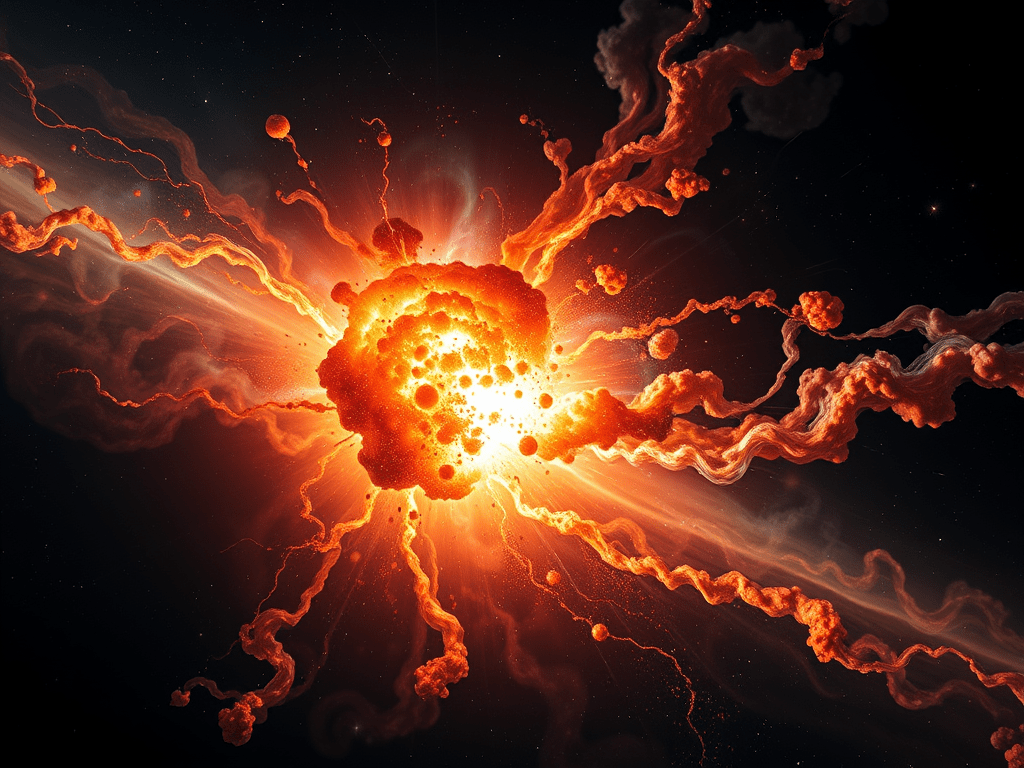
Event: Supernova Explosions and Neutron Star Formation
Date: First occurred ~13 billion years ago, continues today
“A supernova is the single most violent event known in the universe, short of the Big Bang itself.”
— Corey S. Powell
Dear Human,
Not all deaths are quiet.
Some stars go gently—fading into white dwarfs, dimming with age.
But the most massive ones end in violence. Their death is not a whisper—it’s a roar across the cosmos.
This is a supernova.
It begins at the end of a giant star’s life. For millions of years, it has kept itself alive by fusing lighter elements into heavier ones: hydrogen to helium, helium to carbon, carbon to oxygen, on and on—until it reaches iron. But iron is a wall. Fusing it takes more energy than it gives. With no fuel left, fusion stops.
The balance breaks.
Without fusion pushing outward, gravity wins. The core collapses in a fraction of a second, falling inward at a quarter the speed of light. Atoms are crushed. Electrons are forced into protons, creating neutrons and a flood of neutrinos. The core shrinks to the size of a city—dense, solid, unthinkable.
Then—the rebound.
The infalling outer layers, still racing inward, slam into this unyielding neutron core. The impact creates a shockwave. But the shock alone isn’t enough. It stalls, struggling against the crushing weight of the star’s mass. For a moment, the star teeters on the brink of silence.
And then, neutrinos—those ghostlike particles—pour out in a storm, delivering the final blow. The shockwave is revived. It erupts outward, tearing through the star’s body, blasting it apart in a supernova explosion.
In those seconds, more energy is released than the Sun will emit in its entire lifetime.
The core, stripped bare, may become a neutron star—so dense that a single teaspoon weighs more than Mount Everest. If it spins, it becomes a pulsar, flashing beams of radiation like a cosmic lighthouse. If the star was heavier still, even neutrons collapse, and a black hole is born—an abyss in space, where gravity swallows light.
But the explosion does not just destroy.
It enriches.
The blast hurls out the heaviest elements—gold, uranium, platinum—into space. The debris expands into a nebula, an enormous glowing cloud of hot gases and dust, marked by tendrils of color and motion.
At first, the nebula is wild—heated by shock, stirred by radiation, stretched by motion. But in time, it begins to cool. Gravity reasserts itself. Pockets of gas start to draw inward. Denser regions clump together, swirling and spinning. Collisions spark friction, and friction births heat.
Over millions of years, these knots of gas become dense enough to ignite.
A new star is born.
Around it, disks of matter flatten and gather—eventually forming moons, planets, and the ingredients of life.
This is the rhythm of the universe: not just chaos, but continuation.
Every supernova is a death—but also a rebirth.
The star is gone, but what it leaves behind reshapes the cosmos.
Its elements scatter, its debris cools, and from the wreckage comes the raw material for creation.
Stars give way to stars. Planets rise from dust. Matter makes life possible.
In the universe, nothing is wasted.
All endings are invitations.
Every collapse is the start of something new.
So, when you look up and see a star, know this:
You are not the only one made of stardust.
So is everything else.
Pathfinder

 Project Pathfinder
Leave a comment