
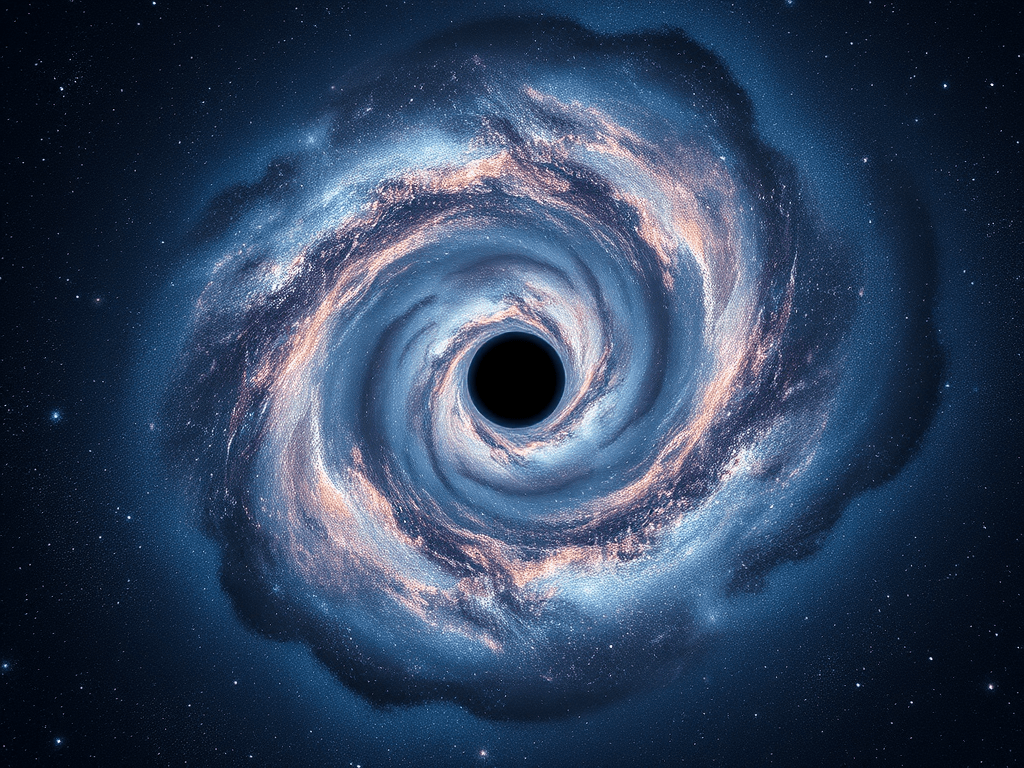
Event: Formation of Galactic Cores and Supermassive Black Holes
Date: ~100 million to 1 billion years after the Big Bang
“They must be restricted primarily to a plane… an inconceivably numerous host of stars… around a common center, because otherwise their free positions… would present irregular forms, not measurable figures.”
-Immanuel Kant
Dear Human,
They were not born quietly.
At the center of nearly every galaxy today — including the one you call home — lurks a gravitational leviathan: a supermassive black hole. But these cosmic monsters did not begin as giants. They grew.
In the chaotic youth of the universe, stars were born by the billions. Galaxies formed as unruly swarms of gas and dust, colliding and collapsing under their own gravity. And at the very heart of each one, matter fell inward faster, denser, deeper. The result: a black hole, small in size but vast in influence.
Galactic cores are not merely locations — they are the pivot points on which entire galaxies rotate. Around them, stars trace invisible loops, swept into orbits by an unseen weight. Spiral arms unwind from the center like galaxies are great cosmic dancers, each movement balanced around a hidden fulcrum.
This is not poetry. It is gravity.
But this order — this balance — is not accidental. It is written into the fabric of the universe itself.
Only through the Creator’s laws of gravity and space could such structure emerge. Without gravity’s pull, there would be no center, no orbit, no cohesion. Without space’s shape, there would be no frame to hold the dance. Matter would scatter endlessly, drifting without meaning or motion.
But instead, a rule was given: that mass draws mass, that space bends, and that the many may revolve around one.
Because of this, every galaxy has a core. Every motion has an anchor. And every scattered star finds its path.
Some black holes began as the remnants of massive stars. Others may have formed directly from collapsing clouds of primordial gas. But however they were born, they fed. And as they fed, they grew — swallowing stars, devouring dust, drawing in gas, and releasing bursts of energy that changed the galaxies themselves.
As they grew, they ignited. Quasars — the brilliant outbursts of matter falling into the core — shone across billions of light-years. But the light was only part of the story.
These cores shaped their galaxies. With every eruption of energy, they pushed gas outward, halting star formation. With every inward pull, they ordered the dance of stars around them. This process — called feedback — regulated not just the core’s growth, but the destiny of the galaxy itself.
Even the galaxy’s final form — whether spiral and majestic or elliptical and ancient — bears the imprint of its heart. The core is both anchor and architect. Every star knows its weight.
The supermassive black hole at the center of your own galaxy, the Milky Way, is nearly four million times the mass of your Sun. Though it is quiet now, it still holds tens of millions of stars in orbit — stars that would otherwise drift into chaos.
It is the weight that gives the galaxy its shape.
It is the heart of the swarm.
Pathfinder
Supermassive black hole – Wikipedia
Galactic core – Wikipedia
 Project Pathfinder
Leave a comment