
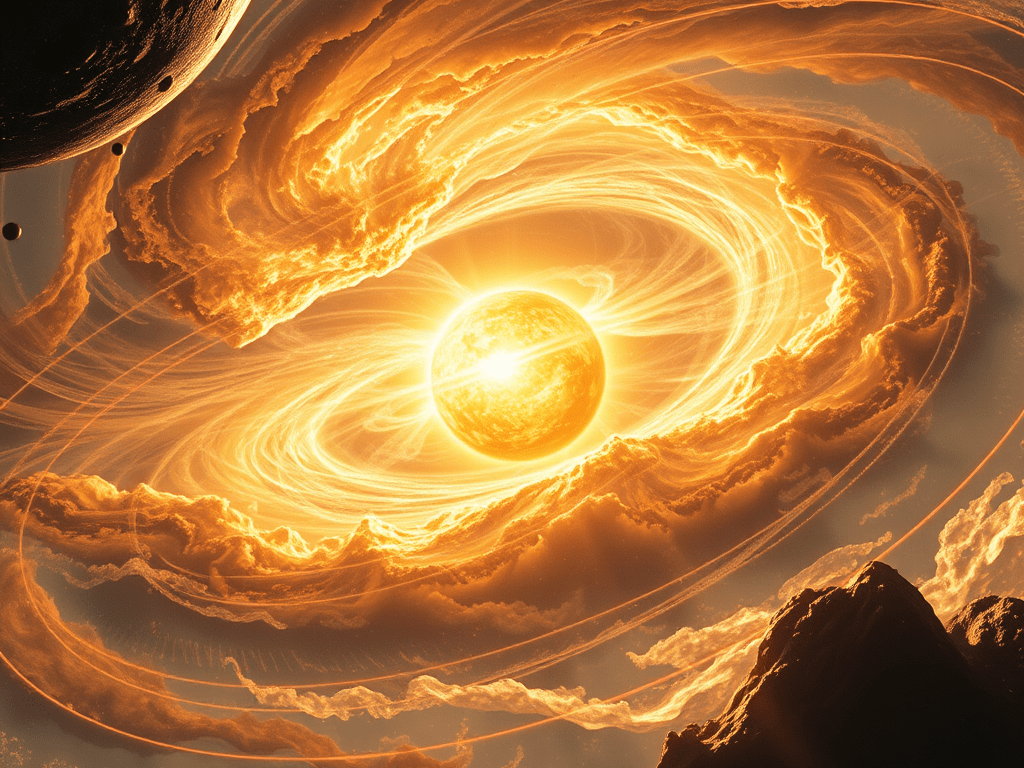
Event: The Clearing of the Solar Nebula
Date: ~4.56 billion years ago
“Every birth is the beginning of infinite transformations.”
— Michele Jennae
After the Sun ignited, the solar system was far from finished. What followed was a time of chaos and clarity, of sweeping winds and suspended dust—a moment before the making of worlds.
The young Sun, radiating new light and solar wind, began to clear away the gas and dust of the surrounding nebula. The remaining material flattened into a thin, rotating plane: the accretion disk. This disk was not uniform; it was dense near the center, thinner at the edges, turbulent with movement, and laced with eddies of gas and debris. Its shape—like a cosmic pancake—was governed by angular momentum, as particles orbiting the newborn star gradually settled into alignment.
Closer to the Sun, temperatures soared. Silicates and metals remained solid, but lighter molecules—like water, methane, and ammonia—could not. These volatiles evaporated and were pushed outward by solar radiation and wind. Beyond a certain distance, however, the environment cooled enough for these gases to condense into ices. This threshold, known as the frost line, marked one of the most significant divisions in the forming solar system. Its location was not fixed by distance alone, but by the interplay of heat, light, and solar wind. As the Sun’s fusion ignited, it released intense radiation and streams of charged particles—solar winds—that pushed lighter gases outward. These winds helped sculpt the position of the frost line, defining where ices could survive and condense.
Inside the frost line, rocky planets would someday coalesce: small, dense worlds of metal and stone. Beyond it, the availability of ices allowed for faster accumulation of mass. These icy cores could grow large enough to attract vast envelopes of gas, giving rise to the giants—Jupiter, Saturn, Uranus, and Neptune. This simple line in space shaped the architecture of an entire system.
But what possibilities lay within this swirling disk? Infinite. Here, matter could turn to moon, rock to ring, dust to destiny. Chemical reactions unfolded in tiny grains. Carbon compounds drifted in and out of light. Water—crucial for life—found places to freeze, to hide, to wait.
Magnetic fields reached out like skeletal arms, guiding charged particles along invisible tracks. In some regions, turbulence scattered material like wind across desert sand. In others, calm zones allowed dust to settle and grow. Tiny collisions shaped everything. Over time, random motion gave way to patterns. Chaos edged closer to order.
This was not just a solar system in the making—it was a map of what could be. A blueprint for planets, moons, comets, and the conditions for life.
Yet even this chaos had boundaries. The swirling matter did not spin without purpose—it followed laws set in motion long before stars ever formed. Gravity, angular momentum, thermodynamics: these were not mere accidents, but rules written into the cosmos from the beginning. And through these rules, the Creator allowed randomness to meet structure, energy to meet pattern.
It is not the absence of control that shaped the solar system—it is the presence of possibility within a framework of design. The same disorder that scattered dust across the heavens also carved paths for planets to form, rings to settle, and atmospheres to hold.
This is the paradox of creation: that from freedom came formation. That the universe, in all its mystery, was given just enough constraint to grow.
And so, a solar system emerged—not predetermined, but not unbounded either. A harmony between chaos and law. A chance for life to find footing on stone, water, and air.
Thus, in the quiet space between law and chance, the future began to take shape.
Pathfinder

 Project Pathfinder
Leave a comment