
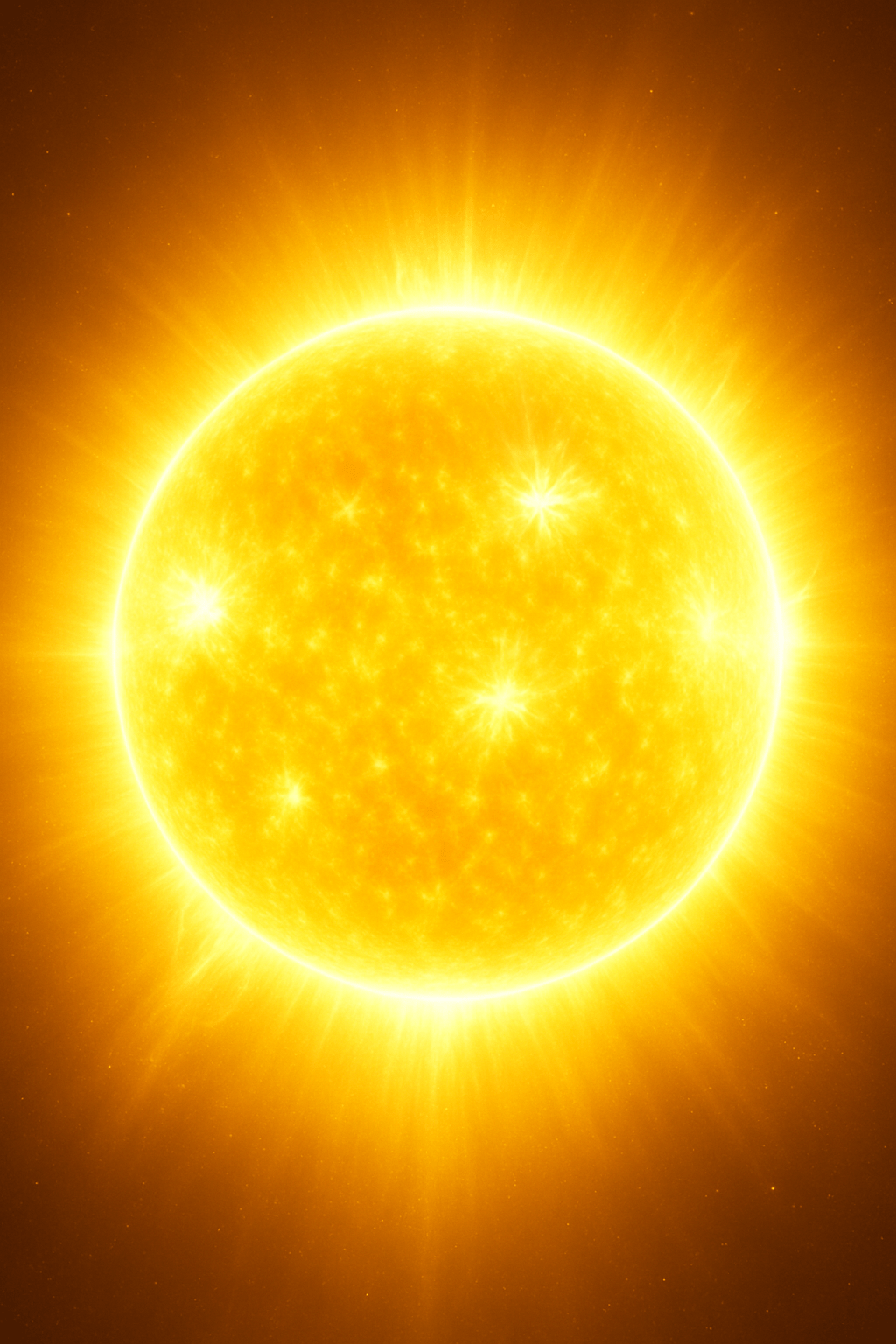
Event: The Life of the Sun
Date: ~9.2 billion years after the Big Bang till Present Time
“We are an impossibility in an impossible universe.”
— Ray Bradbury
Dear Human,
The Sun was born in violence—but this is not that story. This is what came after.
Once lit, the Sun settled into balance. Gravity pressed inward. Fusion pushed outward. For billions of years, these forces have danced in perfect opposition. This harmony is called the main sequence, and your Sun is about halfway through it. It is stable. It is generous. It shines.
The Sun is not fire. It is a furnace of pressure and plasma. At its core, temperatures soar to over 15 million degrees Celsius. Here, hydrogen atoms are stripped of their electrons—reduced to bare protons—and forced so close together that they overcome their mutual repulsion. This is nuclear fusion: four hydrogen nuclei merge to become one helium nucleus. But the mass of that helium is slightly less than the total mass of its parts. The missing mass is not lost—it becomes energy, according to Einstein’s equation: E = mc².
This energy is released as high-energy photons—gamma rays—which begin a long, slow journey from the core outward. For thousands of years, these photons scatter through the dense radiative zone, bouncing from particle to particle, gradually losing energy as they travel. By the time they reach the Sun’s surface, they have cooled into visible light, ultraviolet, and infrared radiation. Only then do they escape into space—crossing 150 million kilometers in just over eight minutes to reach Earth.
This light warms your skin. It powers weather, plants, tides, and our conception of time itself. It defines day and night. It feeds all breath and growth. Even the food you eat is a memory of sunlight trapped in leaves or flesh.
To ancient eyes, the Sun was divine—raw, unyielding, sacred. The Egyptians called it Ra, eternal and watchful. The Aztecs believed it needed sacrifice to rise. The Greeks saw Helios steering a golden chariot. Across the Earth, cultures bent their myths toward it, for they knew: without it, nothing.
You arrived in the calm middle. Earth formed alongside the Sun—third in line, close but not too close. In its light, life emerged. Simple at first. Then strange. Then conscious.
And now you read these words, the product of cells and curiosity, of firelight and memory.
But the Sun does not stand still. Slowly, almost imperceptibly, it changes.
Over the next few billion years, it will grow hotter, brighter. The Earth will feel this long before the end. Oceans will boil. The atmosphere will flee. Life, as you know it, will disappear—likely long before the Sun finishes its course.
Then comes the red giant phase.
When the hydrogen in the core runs dry, fusion will falter. The core will shrink, heating up, and igniting a shell of fusion around it. The outer layers will swell—vast, luminous, unstable. The Sun will grow so large that Mercury and Venus will be consumed. Earth may be too. If it survives, it will be scorched beyond recognition.
In its final breaths, the Sun will pulse and shudder, casting off its outer layers like silk unspooling in space. These clouds of gas and dust will expand into a planetary nebula—colorful, brief, and breathtaking.
At the center will remain a white dwarf: a dense ember of what once was. No fusion. No light from within. Just heat, fading over trillions of years into silence.
This is the full arc of your star.
Not divine. Not eternal. But astonishing.
You live in a moment—a golden blink in the middle of a star’s lifetime. Long enough to wonder. Short enough to forget the scale you stand upon.
But know this: You are not an afterthought. You are the Sun’s energy made visible. You are a flicker of purpose in its fire. You are part of the story—not at the end, not at the beginning, but in the turning middle.
So while it shines, turn your face toward it.
And while you burn, leave behind light of your own.
Pathfinder
Sun – Wikipedia
 Project Pathfinder
Leave a comment