
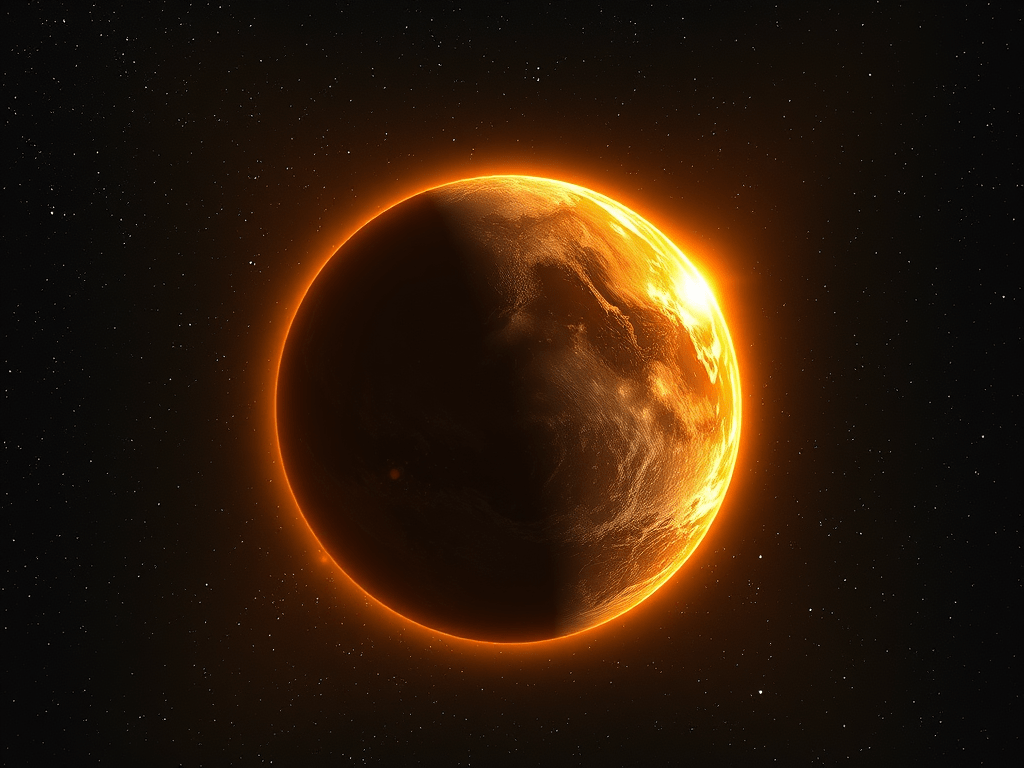
Event: The Planet Mercury
Date: ~4.5 billion years ago
“We are like butterflies who flutter for a day and think it is forever.”
— Carl Sagan
Dear Human,
The first to circle the Sun is also the hardest to hold still. Mercury races through space, orbiting faster than any other planet—yet it turns on its axis so slowly that a single day there lasts two full years. It is a world where motion and stillness share the same ground.
Long before telescopes, ancient sky-watchers tracked Mercury’s fleeting appearances. It never strays far from the Sun—only glimpsed at dawn or dusk. To the Babylonians, it was both Nabu and Ninurta, gods of writing and war, depending on its place in the sky. The Greeks named it Hermes, the wing-footed messenger between realms. The Romans called it Mercury—god of travel, commerce, and transformation.
These myths left their mark. In the language of alchemy, Mercury (quicksilver) was the spirit of change, a bridge between worlds—fluid, elusive, necessary. It was said to represent the mind, ever-shifting. Fitting for a planet that resists easy understanding.
Mercury’s story begins like all planets—in dust and violence. In the young solar system, it may have formed farther from the Sun and been pulled inward, or perhaps it was once a larger world, shattered by collision, its outer layers blown away. What remains is dense and strange: a planet that is more core than crust, with iron making up over 80% of its volume.
Despite its small size, Mercury has a magnetic field—a surprise to scientists, since such fields are usually reserved for larger, faster-spinning worlds. This suggests a partially molten, active core still stirs within. Its surface, however, is silent and scarred: ancient impact craters, volcanic plains, and massive cliffs called rupes, formed as the planet cooled and shrank, warping the crust like a collapsing drum.
Mercury spins three times for every two orbits—a 3:2 resonance locked in by tidal forces. This means that if you stood on its surface, the Sun would rise slowly, hang for days in the sky, then set in a motion that defies Earthly rhythm. A single solar day lasts 176 Earth days.
And then there are the extremes. With no atmosphere to hold heat, temperatures swing violently—from 430°C in the blazing sunlight to -180°C in the shadowed dark. Yet even here, water ice persists in the eternally shaded craters near Mercury’s poles, hidden from sunlight in a scorched world.
Its orbit itself once puzzled astronomers. Mercury does not move in a perfect ellipse—its path subtly wobbles. For centuries, this precession defied Newton’s laws. It wasn’t until Einstein’s theory of general relativity bent space and time that Mercury’s path finally made sense. The smallest planet became a key to the greatest equation.
Modern eyes have only recently drawn near. Mariner 10 was the first to visit in 1974, revealing a lifeless yet complex world. Decades later, MESSENGER orbited Mercury and mapped it in detail, uncovering mysteries of magnetism and mineral. Now, BepiColombo sails through the void to meet Mercury again, its arrival set for 2025.
Mercury has no moons. No rings. No air. It whispers with magnetic breath and keeps its secrets under rock and shadow. Yet for all its silence, it has shaped human understanding across centuries—from gods and glyphs to physics and photons.
It is a paradox: fast and slow, scorched and frozen, ancient and transformative. The first planet, and the first to reveal that the universe is not quite what it seems.
Pathfinder
Mercury (planet) – Wikipedia
 Project Pathfinder
Leave a comment