
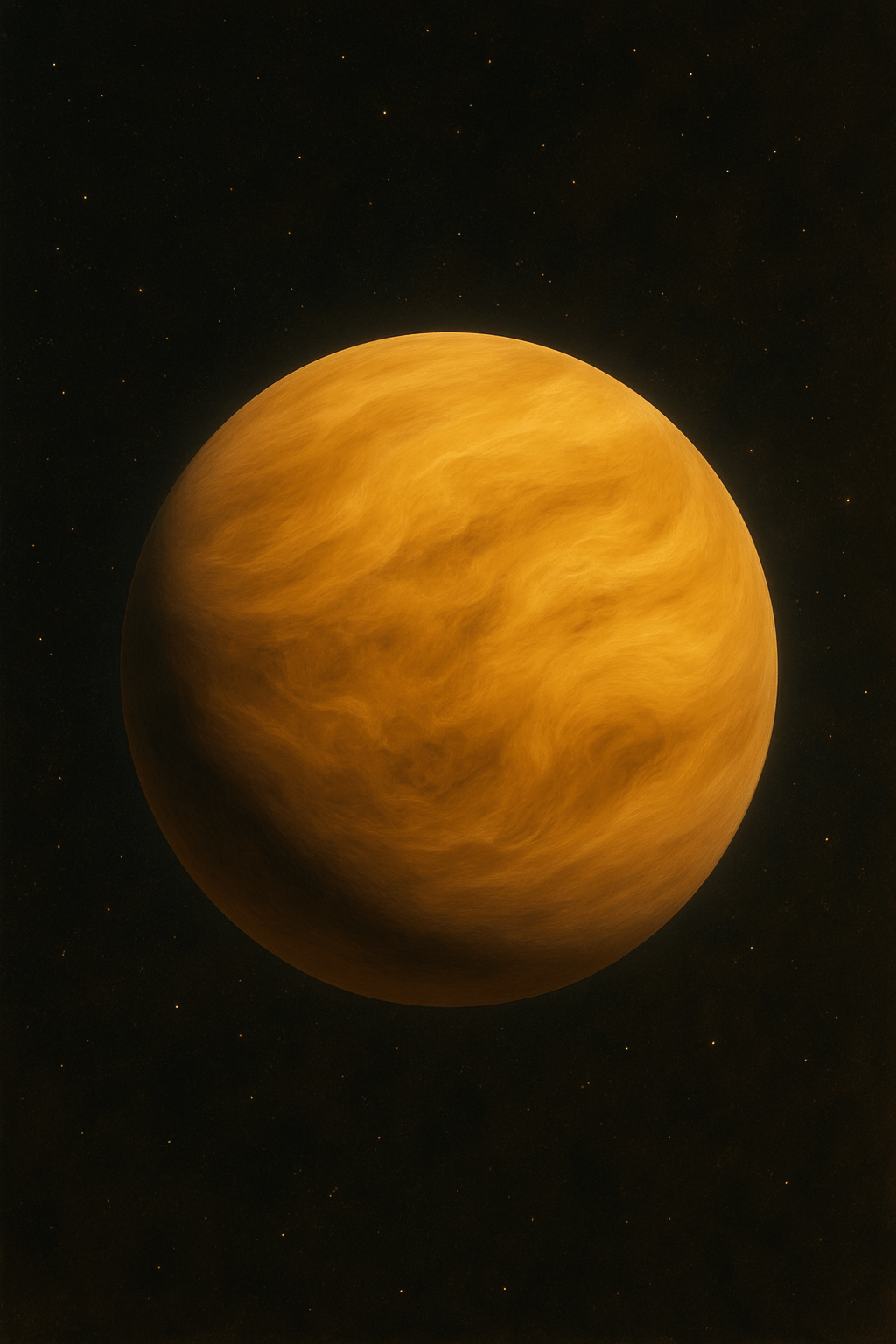
Event: The Planet Venus
Date: ~4.5 billion years ago
“The heavens declare the glory of God; the skies proclaim the work of his hands.”
— Psalm 19:1
Dear Human,
She is the brightest light in the sky after the Sun and Moon—the morning star, the evening beacon. Venus is radiant, veiled in clouds, and dangerously misunderstood. From afar, she dazzles. Up close, she scorches.
Venus and Earth were born as twins. They are nearly the same size, mass, and density. Both orbit within the Sun’s habitable zone. Both formed from the same swirling disc of rock and metal. For a long time, it was believed that Venus might be Earth’s mirror: a lush, tropical world hidden beneath cloud.
But the truth is more severe. Venus is a vision of what Earth might have become. Beneath her bright clouds lies a crushing atmosphere, 90 times thicker than Earth’s, made almost entirely of carbon dioxide. Her skies rain sulfuric acid. Her surface burns at 470°C—hotter than Mercury’s, even though she is farther from the Sun. This is the greenhouse effect in its most violent form.
She spins backwards—a slow, languid rotation in the opposite direction of most planets. A day on Venus (one full spin) lasts 243 Earth days, longer than her 225-day year. And yet her atmosphere circles the planet in just four days, whipping faster than hurricanes, in a phenomenon scientists still do not fully understand.
Geologically, Venus is alive but quiet. Her surface is volcanic, paved with ancient lava flows and crowned with massive shield volcanoes. There are no plate tectonics here, no shifting continents. But something stirs beneath—a world that may erupt again.
In myth, Venus was always the goddess of love and beauty. In Babylon she was Ishtar, in Greece Aphrodite, in Rome the planet kept her name. But the ancients were not blind to her dual nature. Ishtar was also the goddess of war. Venus is beautiful, but she burns.
She has haunted human dreams and telescopes alike. Galileo’s observations of Venus’ changing phases proved she orbited the Sun, not Earth. This small world helped shift the center of the universe. Yet when we finally sent machines to her surface, they barely survived. The Soviet Venera landers were crushed and cooked within minutes. Still, they sent back images: flat, broken plains beneath a heavy orange sky.
We once imagined jungles. We found deserts of death. Yet she remains vital. Venus teaches us what happens when balance is lost—when a planet cannot breathe. She is a warning written in rock and cloud.
Earth’s twin is not our sister. She is our shadow.
Pathfinder
Venus – Wikipedia
 Project Pathfinder
Leave a comment