
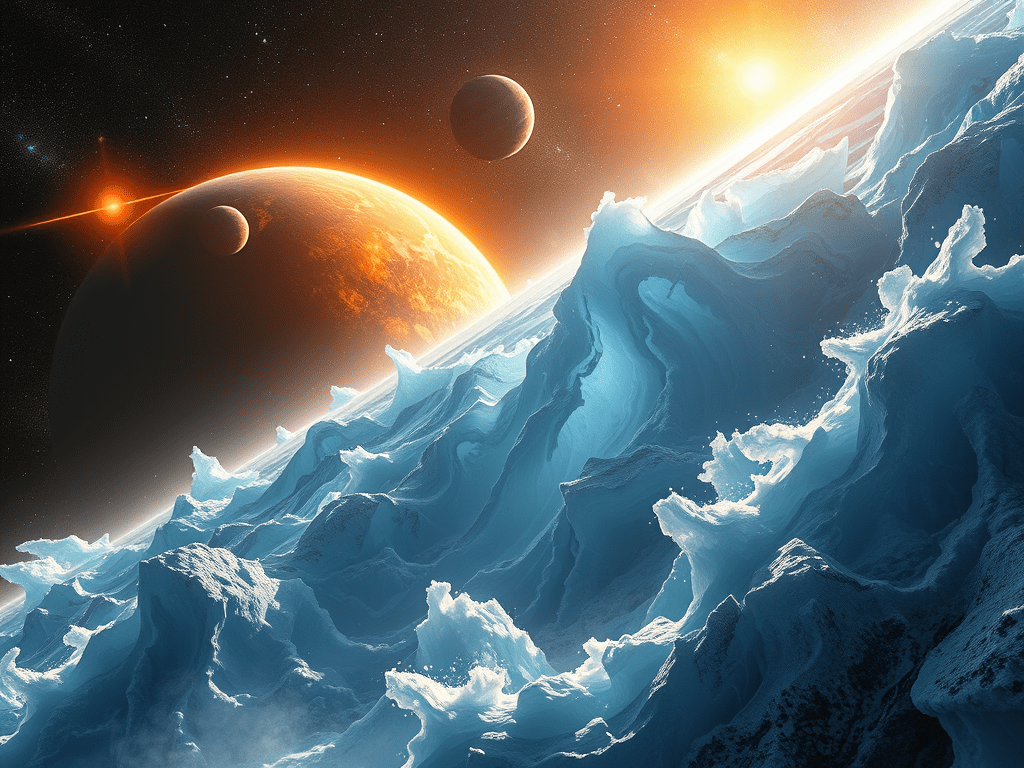
Event: The Frost Line Forms
Date: ~100,000 to 1 million years after the Sun’s ignition
“The laws of nature are but the mathematical thoughts of God.”
— Euclid
Dear Human,
There is a place in the young solar system where everything changes.
Closer to the Sun, the heat is relentless. Ice cannot survive. Gases stay light and restless. Only metal and rock can endure the fire, slowly clumping together to form the rocky worlds: Mercury, Venus, Earth, and Mars.
But farther out, in the quiet chill beyond a certain threshold, something else becomes possible. Here, water freezes. Carbon dioxide, methane, ammonia—each condenses into ice. These ices cling to dust grains, adding weight, stickiness, and mass. This is the frost line—the boundary between flame and freeze, where solid materials suddenly multiply. It formed where heat could no longer chase the cold. Near the Sun, radiation kept space warm, too warm for ice to form. But farther out, the nebula cooled just enough—to around 150 Kelvin—for water vapor to freeze solid. This boundary was shaped by sunlight, pressure, and the thinning breath of the gas disk. In the earliest days, the frost line lay about three to four times farther from the Sun than Earth is today, though it shifted with time as the solar system settled.
Solar winds also played their part. As the young Sun blazed into life, it unleashed streams of charged particles that swept through the disk. These solar winds helped clear the inner system of light gases, pushing volatiles outward and reinforcing the divide between warm and cold, rock and ice. The strength of these winds influenced where the frost line stabilized—shaping the architecture of planets yet to be born.
On one side of this line, only rock and metal could endure. Here, the inner planets grew small, dry, and dense—limited by what they could cling to. Inside the frost line, water could not take hold. The Sun’s heat was too strong, the air too thin, the dust too dry. Any ices that drifted inward vaporized long before they could bind to stone. The inner planets were born thirsty—formed from rock and metal, but stripped of the simple gift of water. Whatever oceans the Earth would one day hold did not come from here. They came later, from far beyond the line, carried in comets and asteroids that remembered the cold. On the other side, ices and gas flowed freely, adding mass and momentum. In that cold abundance, worlds like Jupiter and Saturn were born—planets massive enough to capture atmospheres straight from the void.
Beyond it, planets could grow quickly. They gathered not just rock, but ice and gas—building cores so large they could pull in thick atmospheres. This is where Jupiter and Saturn began, and where the seeds of Neptune and Uranus were sown.
The frost line is not a wall, but a turning point. A thermal divide, drawn by sunlight and distance. Its exact location shifts over time, influenced by solar output, nebular turbulence, and the clearing of gas. But its role remains: it set the stage for what kinds of worlds could exist where.
Even now, long after the frost line first formed, its influence remains. Spacecraft that cross it feel the change. Closer to the Sun, solar panels soak in abundant light, and heat must be shed to keep instruments cool. But beyond the frost line, sunlight thins. Temperatures plunge. Power becomes scarce. Probes must carry their own warmth, their own fire—tiny nuclear hearts wrapped in foil and silence. The cold deepens, the dark expands, and radiation from the giants grows fierce. What was once a line of formation becomes a threshold of endurance—a boundary that separates not just types of worlds, but the kind of machines that can reach them.
Without it, there would be no giants.
And without giants, who would have protected you?
Because they were born beyond the frost line—swollen with ice, swaddled in gas—the giants grew large enough to matter. Jupiter and Saturn became sentinels, their gravity vast and patient. They caught what might have killed you. Their mass pulled in stray comets, shattered asteroids, and flung others far from the path of Earth. They stirred the dust fields, shaped the asteroid belt, and swept clean the dangerous lanes between planets. Without them, the inner worlds might have been broken before they ever had a chance to begin.
They were not made to protect you. And yet they do. Not by intention, but by design. By the quiet laws written into the fabric of creation—laws that made it possible for giants to rise and, in rising, to shield the fragile.
Pathfinder
 Project Pathfinder
Leave a comment