
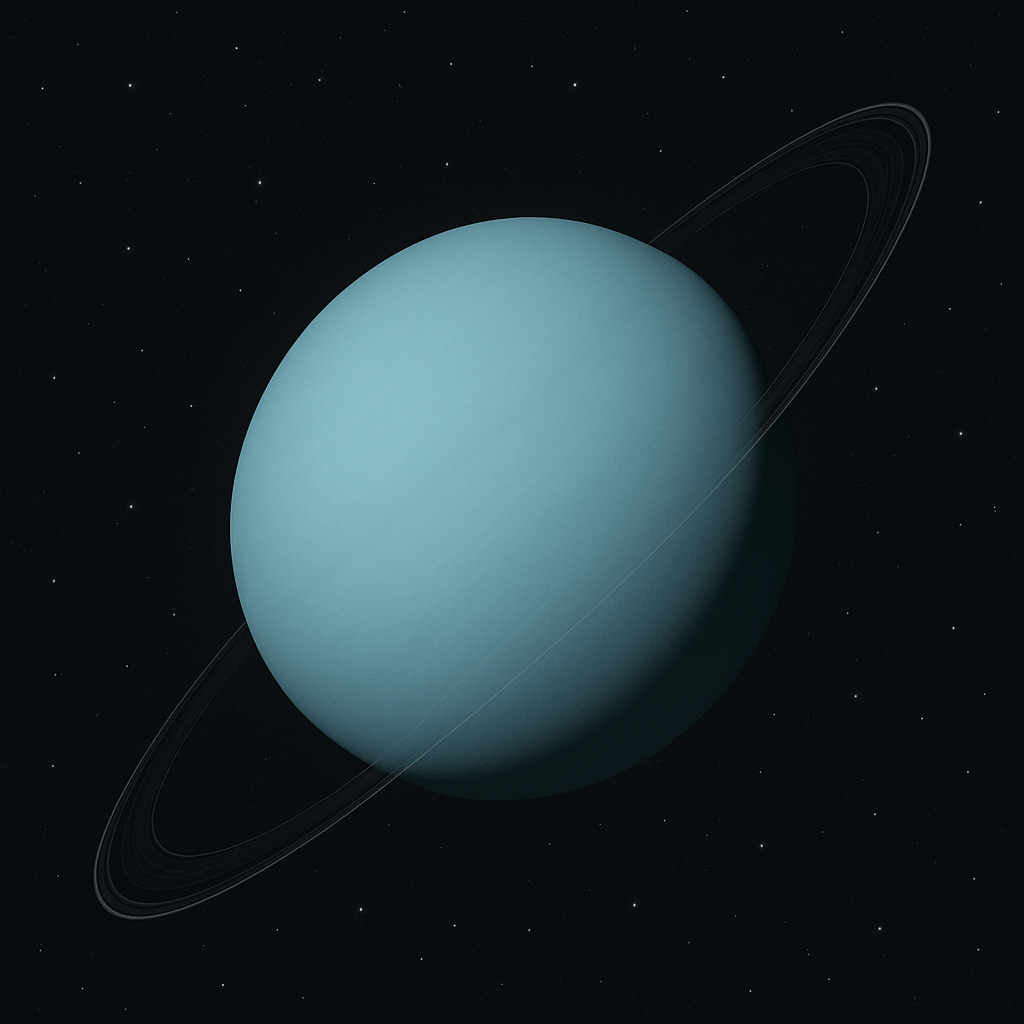
Event: The Formation and Tilt of Uranus
Date: ~4.5 billion years ago
“Even the gods are subject to the wounds of fate.”
— Euripides
Dear Human,
There is a planet that fell sideways.
Uranus, the seventh from the Sun, drifts through space with its body turned nearly perpendicular to its orbit—a pale, cold giant that spins on its side like a wounded marble rolling across the floor of heaven. No other world in the solar system moves quite like this. Something happened long ago—something violent enough to tip a planet.
Most believe it was a collision. A young Uranus, barely formed, struck hard by a body twice the size of Earth. Not enough to destroy it, but enough to change everything. Its axis skewed. Its seasons distorted. Its history rewritten. One year on Uranus lasts 84 Earth years. In that time, each pole takes a long turn bathing in sunlight while the equator lies frozen in twilight. Its seasons are not marked by gentle shifts, but by centuries of slow rotation—echoes of the blow that knocked it down.
And yet it endures.
Uranus is a world of hidden storms and icy silence. It appears smooth and calm, but beneath the pale cyan mask—colored by methane that filters sunlight—rage winds up to 900 kilometers per hour. Storms swell beneath the haze, visible only in infrared. There are no continents or crusts to anchor it—only deepening pressure, swirling hydrogen, helium, and methane gases that blend into oceans of water and ammonia slush, and perhaps rivers of diamond falling toward a rocky core.
Temperatures plunge to -224°C, making it the coldest planet in the solar system. Unlike Jupiter or Saturn, Uranus barely radiates internal heat. Whatever fire it once had now sleeps. The surface does not blaze—it broods.
Its magnetic field is equally strange. Tilted 59 degrees from the planet’s axis and offset far from center, it wobbles and tumbles as Uranus rotates, generating chaotic auroras that burst in strange places, never predictable. It is not a beacon like Earth—it is a ghost lantern, flickering in the dark.
Uranus wears rings—thin, dark, and almost invisible—discovered in 1977 not by sight, but by the way they blinked out a distant star. Thirteen are known. They are not delicate like Saturn’s, but rough and ragged, perhaps the remnants of shattered moons. Its 27 known satellites orbit like a chorus of characters from Shakespeare and Pope: Miranda, Ariel, Titania, Oberon, and more. Their names echo with drama—and so do their orbits.
Uranus was not known to ancient astronomers. It broke the sky’s map in 1781, when William Herschel first spotted it through a telescope. He thought it a comet. But it moved too slowly, too surely. It was not a guest—it was a resident. The discovery changed the definition of what a planet could be. Uranus proved that the cosmos held more than tradition allowed.
Only one visitor has ever approached: Voyager 2, in 1986. It flew past in a few silent hours, snapping the first and only close-up images of Uranus. No mission has returned. The planet remains distant—sideways, silent, strange. It waits in its slow arc, holding mysteries beneath its blue-green shroud: how it formed, what lies within, and what happens when a world is wounded but refuses to fall.
Uranus spins on, retrograde and resilient. Even gods are vulnerable to the weight of time and collision.
Yet they go on turning, battered and wounded; proof that the best path away from trauma is forward. Proof that change is never just an ending, it is also an invitation to a new beginning. Proof that both endurance and hope are part of the Creators infinite design.
Live the lessons that they teach.
Pathfinder
Uranus – Wikipedia
 Project Pathfinder
Leave a comment