
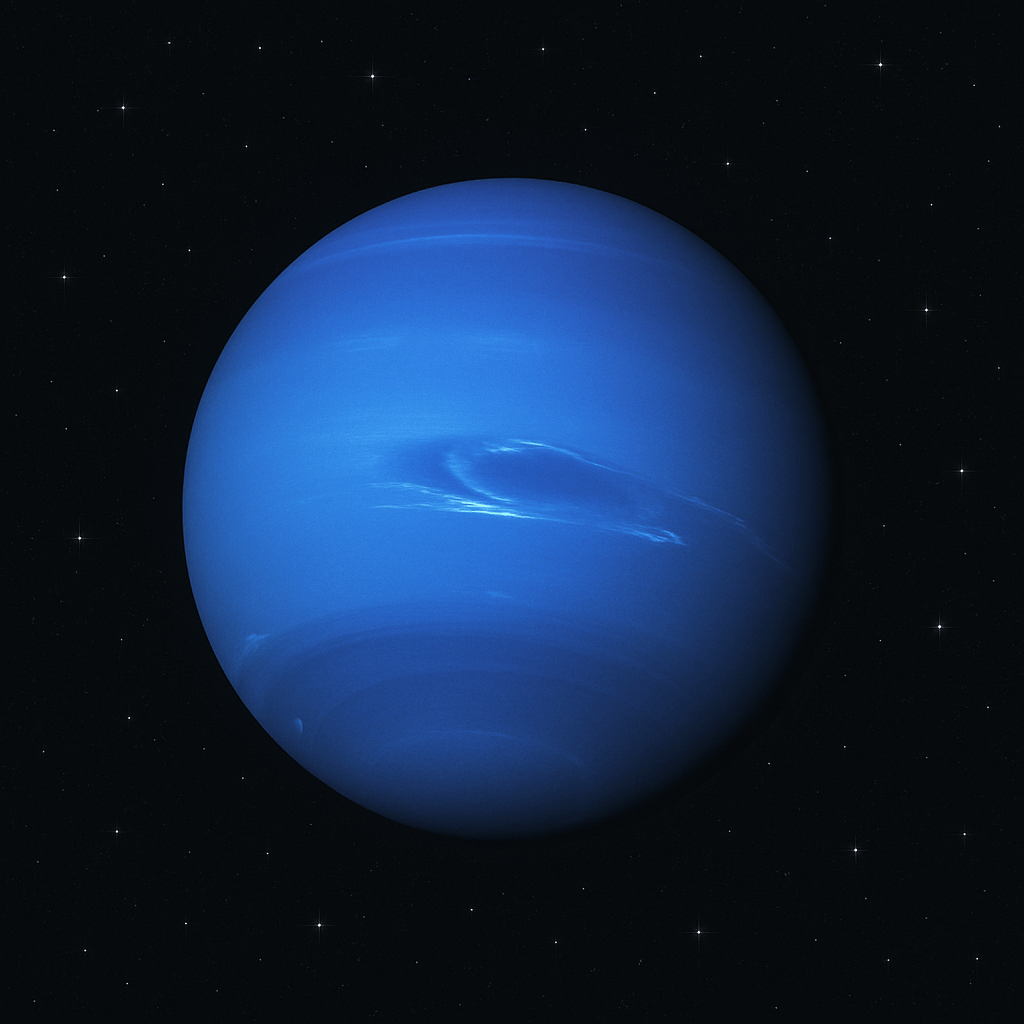
Event: The Formation of Neptune
Date: ~4.5 billion years ago
“The sea, once it casts its spell, holds one in its net of wonder forever.”
— Jacques Cousteau
Dear Human,
At the end of light, there is a sea.
Neptune—the eighth planet, the farthest known—drifts in the solar system’s twilight. It is the last breath of blue before true darkness begins. There are no maps for what lies beyond it. Neptune is not just a world. It is a boundary.
Cold, immense, and howling with winds that defy reason, Neptune defies expectation. It formed in the deep outer disc, where ice could form and gather. But it did not stay put. Pulled outward in the solar system’s early chaos, Neptune may have traded places with Uranus, settling into its post at the edge like a guardian. And from that perch, it watches.
Its surface—if such a word can be used for a planet without ground—is cloaked in rich, royal blue. Methane in its upper atmosphere swallows red light, painting it in the cold hues of an uncharted ocean. But beneath this calm face lies turmoil: storms the size of Earth, hidden maelstroms, winds that reach 2,100 kilometers per hour. It is the farthest planet from the Sun, yet more active than some within. Neptune burns with secrets.
It should be silent. It is not.
Neptune was not discovered by sight, but by the trembling of another. Astronomers noticed Uranus straying from its orbit. They guessed—not wildly, but mathematically—that something unseen was pulling at it. They did not see Neptune first. They predicted it. And when they looked, it was already there.
Only Voyager 2 has ever visited. In 1989, it flew by in silence, catching the storm called the Great Dark Spot—a vast wound in Neptune’s cloud deck that vanished soon after. Other spots have appeared since. They do not last. Neptune reshapes itself often and without warning, like the sea it’s named for.
Its magnetic field is a chaos of angles, tilted far from its axis and offset from its core. It tumbles as the planet spins, producing a field that swirls like tides. Its rings are dark and clumpy—fragments of a former moon, perhaps, or something older still. Triton, its largest moon, orbits backward, a captured rogue with geysers that erupt nitrogen into the void. It’s a frozen object—yet alive. Like Neptune, it doesn’t follow the rules. It writes new ones.
To call Neptune a planet is to tell only part of the truth. It is also a symbol. Of boundary. Of mystery. Of illusion. Like the sea, it appears calm until you enter it. Like the sea, it holds things lost and forgotten. And like the sea, it tempts exploration while resisting it.
Beyond Neptune lies no more certainty. Only the Kuiper Belt, the scattered discs, the slow drift into interstellar dark. If the solar system is a song, Neptune is its fading note—where the melody ends, and the silence begins.
It reminds us: even in cold and distance, there is power. Even at the edge, there are tides.
So venture outward. Beyond here, there be dragons.
Pathfinder
Neptune – Wikipedia
 Project Pathfinder
Leave a comment