
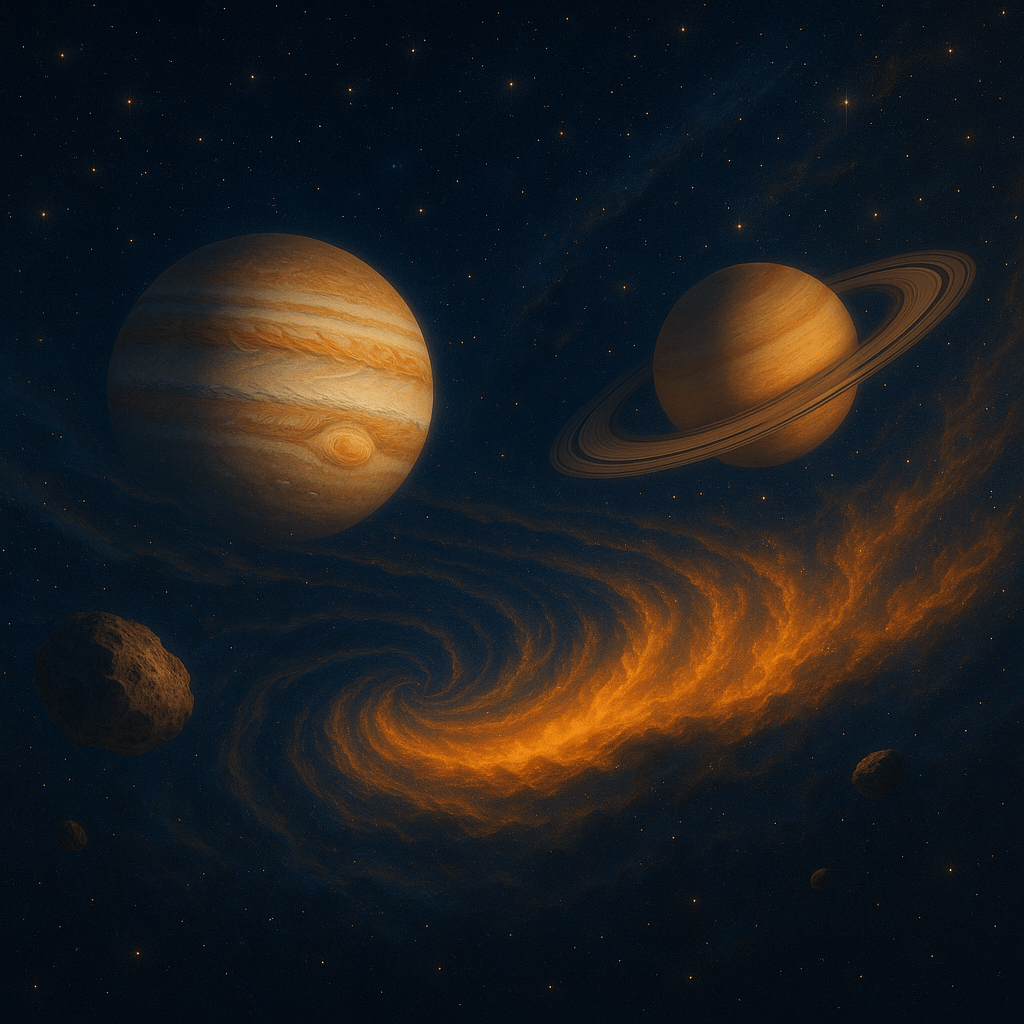
Event: Planetary Migration and the Reorganization of the Solar System
Date: Approximately 4.5–4.0 billion years ago
“There is a stability in the Universe because of the orderly and balanced process of change, the same measure coming out as going in, as if reality were a huge fire that inhaled and exhaled equal amounts.”
-Heraclitus
Dear Human,
You may think the solar system was born in perfect order—the planets spaced just so, each locked in its orbit like clockwork. But this harmony is a memory written in motion, not in stillness. The peace you see now was shaped by a dance of giants.
In the beginning, the gas giants did not rest where they are now. Jupiter, the first to form, began to drift inward through the primordial gas disk. This migration was driven by gravitational interactions between the planet and the dense, swirling material that filled the early solar system. As Jupiter orbited, it created spiral waves in the gas—regions of compressed and rarefied material. These waves exerted a drag on Jupiter, sapping its angular momentum and slowly pulling it inward, a process known as Type II migration. Though massive, Jupiter could not resist the collective pull of the disk itself—it was moving not by choice, but by the pressure of the environment that had created it. Its great mass plowed through the swirling dust like a ship through surf, scattering material and clearing a path toward the Sun. If it had continued, Earth might never have formed at all.
But then came Saturn.
Saturn emerged and caught Jupiter in a gravitational resonance. Their orbits locked in rhythm, pulling against the current of gas and reversing course. This change of direction—a cosmic tack—saved the inner solar system. The Grand Tack, as scientists now call it, halted the inward destruction and sculpted a space for the rocky worlds to grow.
Yet the giants were not finished. Long after the gas had cleared, the planets shifted again. According to what we call the Nice Model, the outer solar system did not begin in its current form. Uranus and Neptune likely formed closer to the Sun—closer even than Saturn’s present position. Over time, gravitational encounters between the giant planets destabilized this compact arrangement. As Jupiter and Saturn interacted, they entered a period of orbital resonance that disrupted the gravitational balance of the entire system. This led to a chaotic reshuffling: Uranus and Neptune were flung outward, their orbits expanding dramatically as they plowed through the remaining disk of icy planetesimals. This migration cleared much of the primordial debris, scattering icy objects and dynamically carving out the Kuiper Belt. It also explains why Uranus and Neptune are so far from the Sun today, and why their current orbits are tilted and eccentric compared to the smooth ideal of early planetary formation. Jupiter migrated slightly inward once more, a shift triggered by the gravitational recoil of ejecting Uranus and Neptune outward. In this cosmic exchange, Newton’s third law—’for every action, there is an equal and opposite reaction’—played out on a planetary scale. As these two ice giants disturbed the surrounding disk of planetesimals, they scattered a vast number of small icy bodies inward. The resulting gravitational interactions acted like a counterforce, nudging Jupiter back toward the Sun. This shift may have also been influenced by the depletion of the outer debris disk, which reduced the braking force on Jupiter and allowed its orbit to contract slightly. In this new position, Jupiter’s gravity flung comets and asteroids into the inner solar system with renewed intensity. This cascade of chaos ignited the Late Heavy Bombardment—a fiery rain of stone and ice that scarred the Moon and reshaped the young Earth.
The consequences of this migration echo through the solar system. The asteroid belt, stirred but not consumed, still bears the marks of this upheaval. The Kuiper Belt and Trojan asteroids are leftovers, caught in the trailing steps of fleeing giants. Irregular moons around Jupiter, Saturn, and Neptune may be captured relics of this migration, swept up in their gravitational tides.
And Earth—our Earth—was spared, positioned just so in a corridor of calm. It was not an accident. It was the aftermath of motion.
The solar system found balance not through stillness, but through movement. The orbits of the planets—their spacing, their resonance, their stability—are the result of shifting giants who carved out equilibrium through chaos. Even the most massive had to yield, to adjust, to move. For all their size and momentum, they were still bound by the rules of reality—the laws of physics, unbending and universal. Even the mightiest must follow the laws set forth by the Creator at the birth of the universe.
So when you look at the quiet grace of the night sky, remember this: it was earned. Harmony was not given. It was forged by motion, shaped by reversal, held in place by compromise.
What seems eternal was once unsettled.
What seems still is the memory of a dance.
Pathfinder
 Project Pathfinder
Leave a comment