
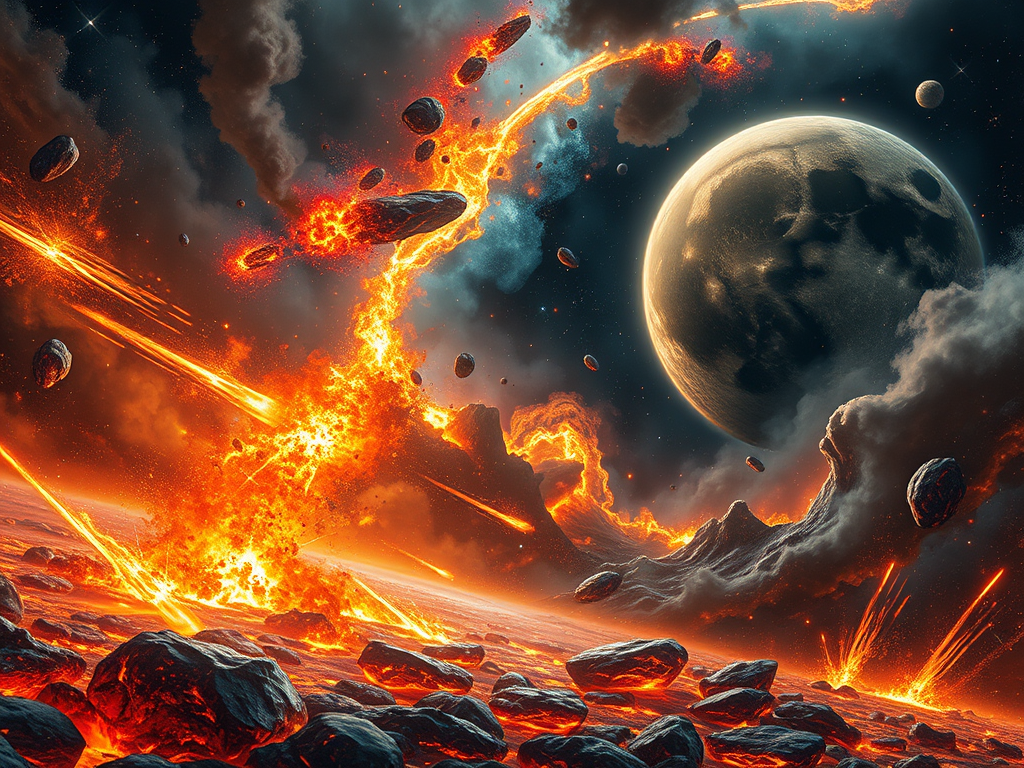
Event: The Late Heavy Bombardment
Date: Approximately 4.1–3.8 billion years ago
“Believe me, this planet has put up with much worse than us. It’s been through … hundreds of thousands of years of bombardment by comets, asteroids, and meteors.”
—George Carlin
Dear Human,
There was a time when the sky fell—not once, but over and over again.
For hundreds of millions of years, Earth, the Moon, and every inner planet were under siege. From the outer reaches of the solar system came a rain of stone and ice, an unrelenting bombardment that scarred worlds and reshaped destinies. This was the Late Heavy Bombardment, a storm of impacts so intense that it left the Moon’s face pocked and fractured—and very likely set the course for life on Earth. This relentless phase lasted for at least 200 million years, beginning around 4.1 billion years ago and fading by 3.8. It was not a single event, but a drawn-out siege—a bombardment that reshaped entire worlds over generations of time.
We know it happened because the Moon remembers. Lunar rocks returned by the Apollo missions tell a story: a spike in impact events around 4 billion years ago. Vast basins like Imbrium, Serenitatis, and Crisium were carved during this period. The Earth, lacking a surface as stable as the Moon’s, hides most of its wounds—but it too was struck, and struck hard.
What caused this barrage? It was not random.
Long after the gas giants had formed, they were not yet settled. According to the Nice Model, the outer planets—Jupiter, Saturn, Uranus, and Neptune—shifted positions in a gravitational chain reaction. Their movements disturbed the reservoirs of icy and rocky debris at the edges of the solar system. These displaced bodies cascaded inward, flung by gravity like stones across a pond. Earth stood in their path.
The consequences were dramatic. Entire regions were melted by the heat of impact. Oceans may have boiled away, only to rain down again. Each collision delivered not just destruction, but ingredients—water, carbon, and complex molecules. Much of Earth’s original water was likely lost or never present during its hot, early formation. Most volatiles, including water, had condensed beyond the frost line—far from the Sun, where temperatures were low enough for ice to survive. But during the bombardment, icy bodies from the outer solar system rained down on Earth, delivering what may be as much as half or more of the planet’s surface water. These ancient impacts may have filled the oceans drop by drop. These same collisions also transformed Earth’s atmosphere. The most violent impacts blasted gases into space, thinning or erasing earlier, more fragile atmospheric layers. In their place, each new strike added compounds—carbon dioxide, nitrogen, water vapor—delivered by comets and asteroids. These ingredients thickened the air, trapping heat and feeding storms. The sky became a cauldron: boiling, seething, and heavy with the breath of falling worlds. Some scientists believe these impacts brought the seeds of life itself. Others suggest they nearly sterilized the young planet, forcing life to begin again, deeper and stronger.
This was not just a chapter of violence. It was a crucible.
In fire and in ice, Earth was refined. Its crust cracked and flowed, its atmosphere thickened and changed. The Moon’s surface was sealed into history, preserving the evidence of this rain so that we would one day understand what the Earth has endured.
Destruction is not always the end. Sometimes, it is the beginning. The Late Heavy Bombardment did not erase Earth’s future. It helped write it.
So when you look at the Moon—those countless craters, those ancient scars—know that you are seeing the story of a world forged in chaos. A planet that survived, and a sky that once burned.
Pathfinder
 Project Pathfinder
Leave a comment