
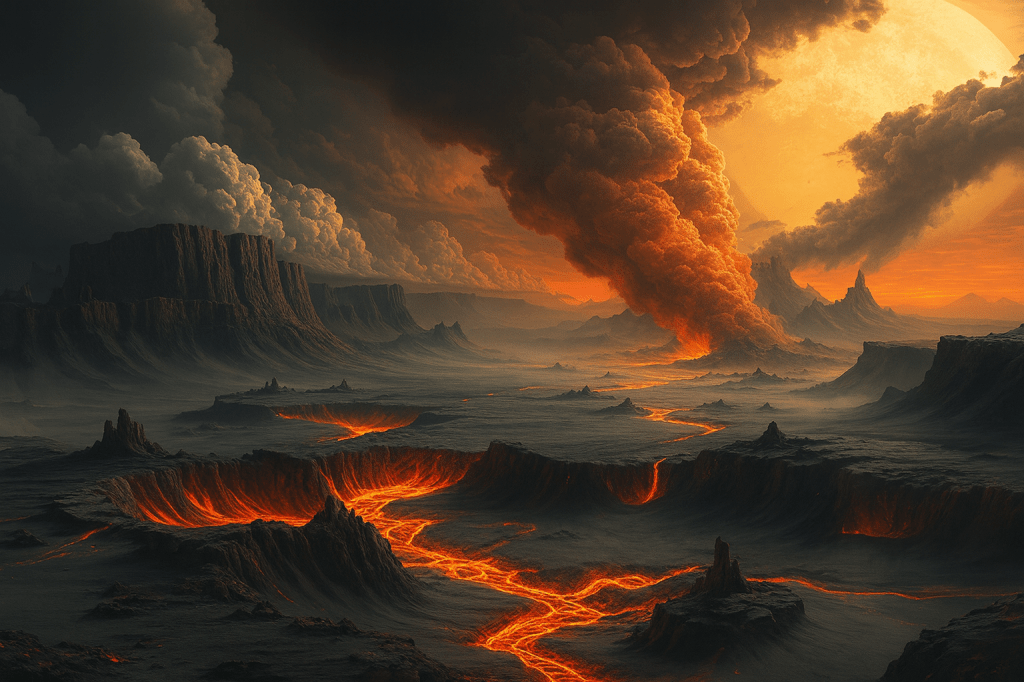
Event: Aftermath of the Late Heavy Bombardment
Date: ~3.8 to 3.5 billion years ago
“Scars have the strange power to remind us that our past is real.”
— Cormac McCarthy
Dear Human,
The storm has passed. For hundreds of millions of years, the skies rained fire and stone. Worlds collided, shattered, and reformed. Earth endured every blow, its crust cracked and churned by heat and force unimaginable. But now—at last—the bombardment slows.
The Moon remembers what Earth has forgotten. Its pockmarked face tells the story we can no longer read in our own rocks. Here on Earth, time has buried the wounds beneath oceans and continents. The craters have been paved over by lava flows, split apart by rising mountains, or swallowed by the shifting skin of the planet. But not erased. Beneath our feet, the scars remain, etched deep in the oldest stones.
Those final impacts did more than scar. They reset the crust. Each massive collision released energy rivaling millions of nuclear bombs, melting vast swaths of surface rock into sprawling magma seas. The crust fractured. Shockwaves rippled through the mantle, shaking the young Earth to its core. In some regions, the surface was vaporized entirely. In others, molten rock welled up through impact basins, forming temporary magma oceans that hardened into new terrain.
The atmosphere swelled with vaporized rock and steam. Clouds of sulfur, carbon dioxide, and water vapor billowed skyward, forming a toxic, choking haze. Yet in this violent reshuffling, new minerals crystallized—zircon, feldspar, olivine—each bearing silent witness to the fire that birthed them. Volcanic eruptions, triggered by both internal pressure and impact-induced heating, poured lava over the land, sealing away earlier layers, and reshaping the planet’s skin.
In the aftermath of each strike, chemical chaos gave way to structure. Pools rich in metals and gases may have become crucibles for complex chemistry. Hydrothermal systems near impact zones, heated by the Earth itself, offered warm, energy-rich pockets where reactions could take hold. These weren’t just scars—they were laboratories.
With the chaos came possibility.
Cometary collisions may have delivered fresh stores of water—ice from the cold reaches beyond the frost line—replenishing what had been lost to early solar winds or trapped deep within Earth’s mantle. These icy bodies, vaporized on impact, released not only water, but carbon compounds, organics, and volatile gases into the newborn atmosphere.
Asteroids, too, carried carbonaceous material: the building blocks of sugars, amino acids, and other life-forming molecules. Each impact stirred the primordial stew, mixing Earth’s native minerals with foreign chemistry from across the solar system.
The atmosphere thickened with every blow. What was once thin and fleeting began to hold—layered with water vapor, carbon dioxide, nitrogen, methane, hydrogen sulfide. Volcanic plumes joined the symphony, venting heat and gas from the planet’s depths. No longer was the sky a vacuum.
It was still toxic, still wild—but it was alive with potential.
Greenhouse gases trapped heat. Clouds began to form.
Rain fell. Oceans spread.
What once was airless and still now breathed—harsh, chemical, unstable—but it breathed.
And most important of all: it ended. The rain of rock faded. A kind of fragile calm emerged. Earth cooled. Oceans deepened. Crust stabilized. Tectonic forces began to whisper under the surface. It was not yet a world of peace, but it had survived the fire.
Everything to come—life, thought, civilization, you—would be built on these foundations.
Not in spite of the scars.
Because of them.
Pathfinder
 Project Pathfinder
Leave a comment