
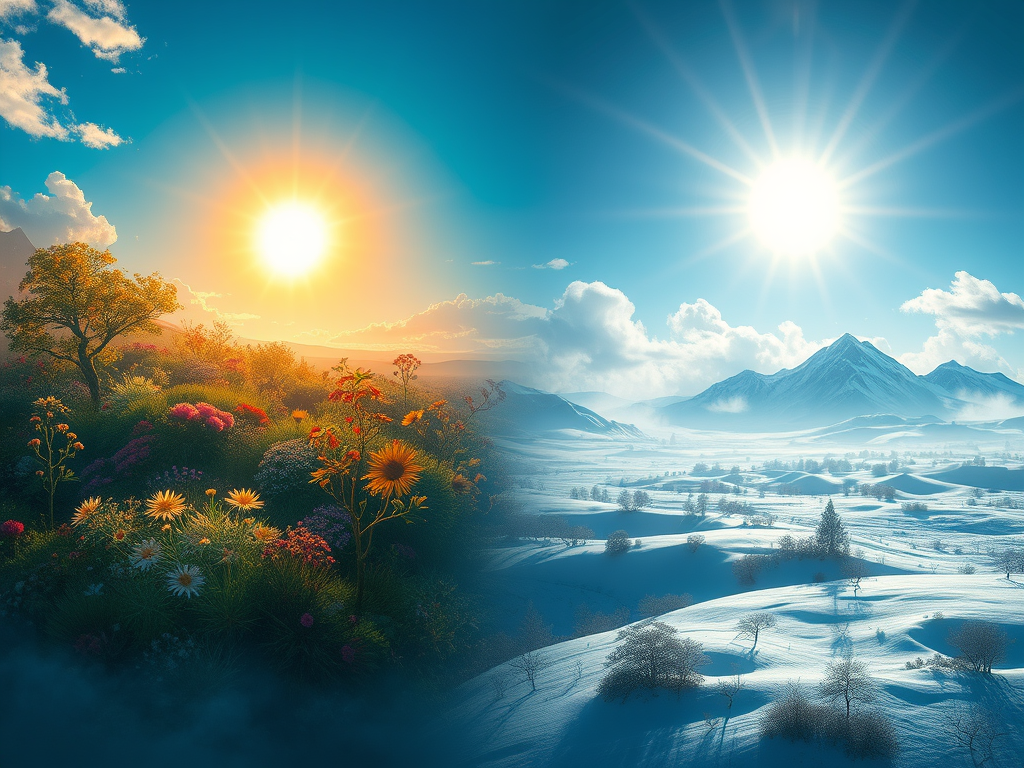
Event: Formation of Earth’s Seasonal Cycle
Date: ~4.5 billion years ago – present
To everything there is a season, and a time to every purpose under heaven. –Ecclesiastes 3:1
Dear Human,
At one turning of the year — the summer solstice — the Sun refuses to leave. It lingers at the crown of the sky, flooding the world with light. Shadows hide, the day stretches to its farthest edge, and night becomes only a fleeting breath. At the opposite turning — the winter solstice — the Sun bows low, its path brief, its warmth faint. Darkness keeps its longest vigil, and the land dreams beneath the weight of night.
Between these two moments lies the slow turning of the light — a steady, eternal trade between day and night, warmth and cold. It is the pulse by which the Earth breathes, and the measure by which all living things keep time.
Your world does not spin upright. It leans — about twenty-three and a half degrees off vertical — tilting each hemisphere toward the Sun for half the year, and away for the other half. As Earth travels its orbit, this fixed tilt changes the Sun’s apparent height in the sky. In the hemisphere leaning toward the Sun, its daily arc climbs higher, the light strikes more directly, and daylight lasts longer. Six months later, the tilt turns away; the Sun rides lower, its light comes in at a shallow angle, and days shorten.
At the equinoxes, neither hemisphere leans toward the Sun. Day and night balance, and sunlight is shared more evenly across the globe. From this simple geometry — a tilted planet holding its posture as it circles the Sun — come the seasons.
Think of the year as a great, rolling wave of sunlight and warmth. Summer is the crest — the peak of the energy cycle — when days are longest and the Sun’s power most concentrated. Winter is the trough — the valley of the year’s light — when days are shortest, nights longest, and heat escapes to space.
Between them lie the transition seasons. Spring is the rising slope, when warmth steadily returns, rivers thaw, and life wakes. Autumn is the falling slope, when warmth ebbs, shadows lengthen, and living things prepare for the lean months ahead.
Seasons shape life’s strategies. In temperate and polar latitudes, plants grow and fruit in summer’s abundance, then shed or store to survive the cold. Animals migrate, breed in time with food peaks, or sleep through scarcity. Insects emerge with flowers; predators follow their prey; entire ecosystems keep time with the Sun.
Near the equator, the Sun’s path and day length change little over the year. Here, the cycle’s peaks and valleys flatten, and life adapts to wet and dry seasons instead, driven by shifting rain belts. Plants may flower year-round, animals breed in any month, and migrations follow water more than warmth.
From poles to tropics, the tilt’s influence is everywhere — sometimes sharp and dramatic, sometimes subtle and slow — but always a rhythm life has learned to match.
The Moon steadies your planet. The Sun sends its light in waves. The tilt carries those waves across the globe. Without this balance, Earth could lurch between extremes — too erratic, too hostile, too still. With it, the planet keeps its rhythm, and life moves in time with its breath.
Pathfinder
 Project Pathfinder
Leave a comment