
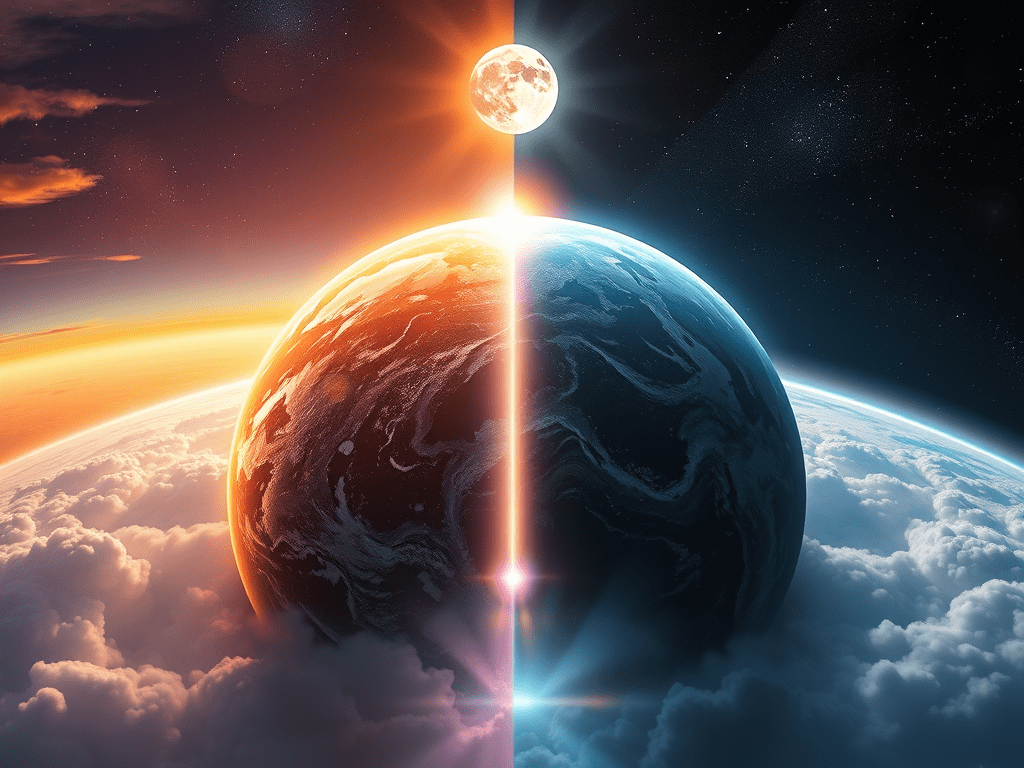
Event: Earth’s Axial Rotation and the Day/Night Cycle
Date: ~4.5 billion years ago – present
“Each morning we are born again. What we do today is what matters most.”
– Gautama Buddha
Dear Human,
Each dawn, the world turns its face toward the Sun. Shadows retreat, warmth spreads, and life begins its work. By nightfall, the Earth has carried you into darkness again, where light lingers only in the stars and moon. This turning — steady, unbroken — is the oldest rhythm of your world, and one that has shaped not just biology, but belief. In every age, humans have watched the rising Sun as a promise of renewal and seen nightfall as a time for rest, reflection, and sometimes fear. Cultures have marked time by sunrise and sunset, prayed to the morning light, and honored the stars that appear when the Sun departs. Around the longest day, midsummer festivals celebrate abundance and warmth. Around the longest night, midwinter gatherings and solstice fires mark the return of the Sun, a promise that darkness will yield again to light.
In its youth, the Earth spun far faster, its rotation a dizzying whirl. In the aftermath of the colossal impact that gave birth to the Moon, a single day may have lasted only five or six hours. Oceans surged under a rapidly turning sky, their tides rising and falling with tremendous energy. Over eons, the Moon’s steady gravitational pull on these oceans created friction against the seafloor — a process known as tidal braking — that gradually drained energy from Earth’s spin. This slow, relentless braking lengthened the day by tiny increments, just fractions of a second each century, while the Moon, in turn, drifted steadily farther from its birthplace. The two remain bound in a quiet exchange: Earth surrendering a little of its spin, the Moon taking distance in return.
The length of a day shapes the planet’s climate and life’s possibilities in profound ways. Shorter days spread light and dark more evenly across the surface, preventing extreme swings in temperature and keeping heat and cold in tighter balance. Longer days give the Sun more time to warm the ground, air, and seas before nightfall, or longer cooling periods if the night is extended, producing distinct cycles of heat and chill that life must adjust to. These patterns influence wind, weather, and the productivity of ecosystems. Over billions of years, nearly every organism has evolved a circadian clock — a complex biochemical and neurological rhythm precisely tuned to the planet’s turning — regulating cycles of sleep and wakefulness, feeding, reproduction, and cellular repair, keeping life’s processes in harmony with Earth’s rotation. This daily rhythm folds into a larger cycle: the year. For each full turn of Earth upon its axis — twenty-four hours of light and dark — the planet also advances a little along its orbit. After 365 such rotations, Earth has traced a complete path around the Sun, marking the passing of the seasons. This interplay between spinning on its axis and circling its star defines the calendar of your world, from the span of a single breath to the turning of generations.
Without the Moon’s influence, the Earth would spin faster, altering wind patterns, ocean currents, and perhaps the very heartbeat of life. If days were much longer, the Sun’s heat could bake the surface for hours before plunging into long cold nights — a pattern that would test the endurance of every living thing. The present balance, a day of light followed by a night of rest, is one of the conditions that makes your world gentle enough to live on.
The Earth’s spin is the first clock, the one written into stone and tide. With each sunrise, the hand moves forward. With each sunset, it comes to rest — only to begin again. The beat of light and dark has never stopped, and as long as the Earth turns, it will keep its time.
 Project Pathfinder
Leave a comment