
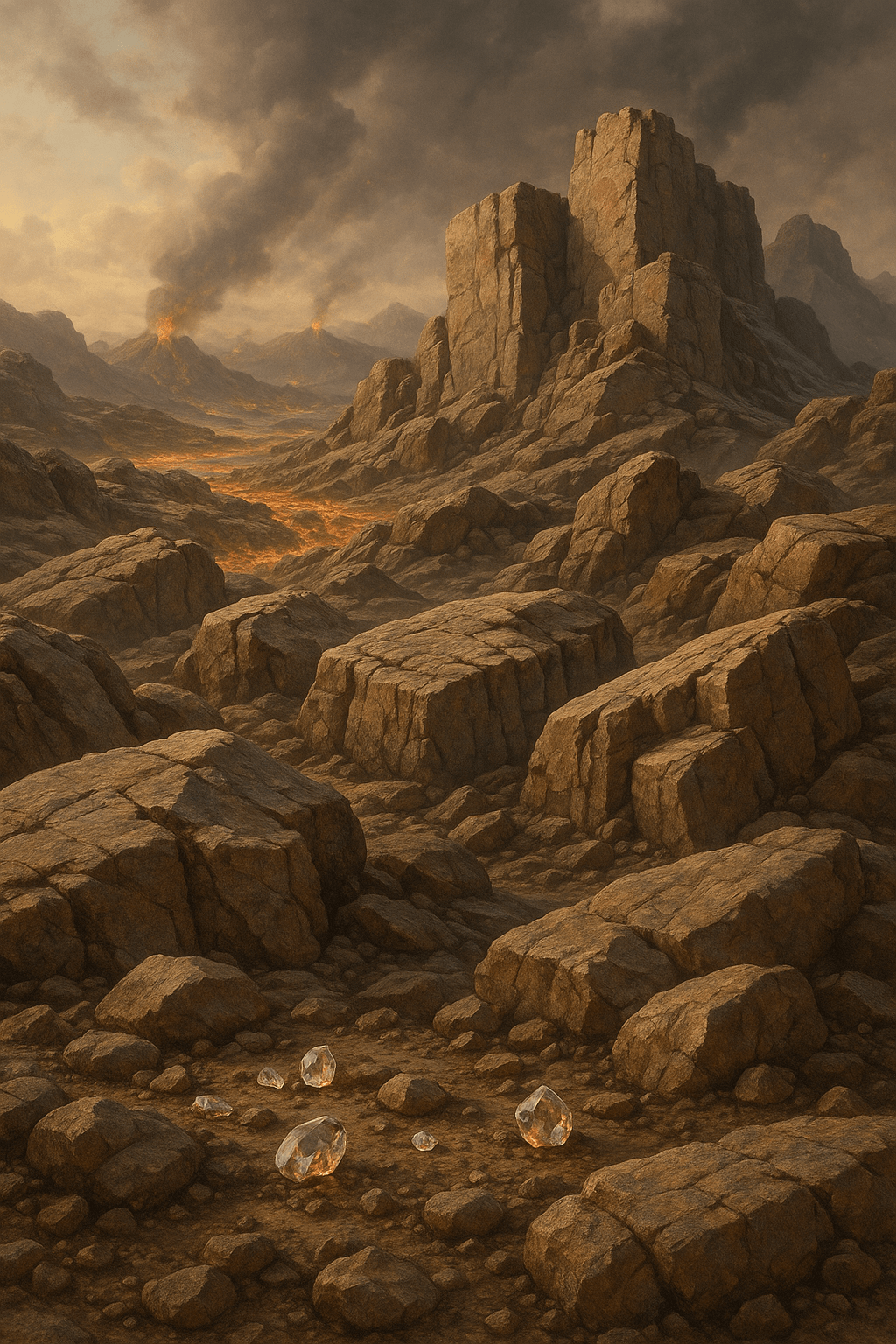
Event: Formation of Earth’s crust and continental cratons
Date: ~4.4 to 3.0 billion years ago
“These rock structures … as if they were the bones of the earth … She identified the oldest rock structures, called cratons … up to 3.2 billion years.”
— Carla Braitenberg
Dear Human,
The fire began to cool.
In the wake of bombardment and chaos, the molten surface of Earth slowly hardened. Thin sheets of solid rock began to form across the planet’s vast, churning face—fragile crusts floating atop seas of magma. At first, they were short-lived. Impacts shattered them. Heat melted them. Convection from below tore them apart. But with time, some pieces endured.
The first minerals were tiny—zircons, no wider than a strand of hair, hidden in grains of ancient sand—but they held remarkable secrets. Formed around 4.4 billion years ago, these crystals are the oldest known materials on Earth. Within their lattice structure, they preserved evidence of the conditions under which they formed: low-temperature crystallization, contact with liquid water, and the presence of stable, felsic crust.
They weren’t born in chaos, but in patches of solid ground, suggesting that even during the Hadean eon, Earth had already begun to cool. These zircons—discovered in the Jack Hills of Western Australia—tell us that Earth had oceans by then. They tell us that crust existed. They tell us that this planet, so often imagined as a seething inferno, may have been quieting sooner than we thought.
Isotope ratios of oxygen and hafnium inside the zircons hint at processes like weathering, recycling, and re-melting—hallmarks of continental crust behavior. And though no rocks survive from that time, these tiny crystals endured. They are the first whisper of land trying to be born—not just in form, but in function: crust stable enough to interact with air and water, stable enough to begin writing Earth’s memory into stone.
Oceanic crust formed quickly, rising from upwelling basaltic magma at mid-ocean ridges. It was dark, dense, and thin—averaging only 5 to 10 kilometers thick. Composed mostly of basalt and gabbro, this crust cooled rapidly and was continuously recycled back into the mantle through subduction zones. Its life cycle was short, dynamic, and largely erased by Earth’s internal churn.
Continental crust, by contrast, emerged through slower and more complex processes. Partial melting of hydrated basaltic crust at convergent margins produced granitic magmas—felsic, buoyant, and rich in silica and aluminum. These magmas solidified into rocks like granite and tonalite, forming thicker, less dense crustal blocks that resisted subduction. With time and repeated tectonic cycling, they accumulated, merged, and stabilized.
These enduring fragments became the cratons—the ancient, stable cores of modern continents. Ranging from 30 to over 70 kilometers thick, they are underlain by deep keels of depleted mantle that anchor them against convection. Found in places like Greenland, Western Australia, southern Africa, and the Canadian Shield, they have lasted for billions of years, surviving continental collisions, supercontinent cycles, and planetary upheaval. They are not just old rocks—many are over 3 billion years in age. Tonalites, granodiorites, and gneisses dominate these regions, often coarse-grained, speckled with light and dark minerals, and shot through with ancient veins. Their textures reveal histories of pressure, melting, and reformation. They are the bones of the Earth, anchoring the restless crust and preserving the memory of a world learning how to last.
As the crust thickened, the heat trapped within the Earth no longer escaped as violently. Volcanoes still erupted, but with rhythm. Tectonics stirred beneath the surface, not in chaos, but in cycles. The planet began to settle. The surface no longer reset with every impact or convulsion—it began to record.
And with that growing stability came space for something new.
Dry land. Shallow seas. Persistent coasts.
A stage where chemistry could slow down.
A home that could remember what it created.
Cratons are still here, beneath your feet—quiet, unmoving, and impossibly old. They remember when the world was molten, and they endured when nothing else could. They are the foundation not only of continents, but of memory itself.
Pathfinder
 Project Pathfinder
Leave a comment