
Event: Ocean Formation and the Birth of the Water Cycle
Date: ~4.0 to 3.8 billion years ago
“Water is the driving force of all nature.”
— Leonardo da Vinci
Dear Human,
Before the oceans, there was only vapor.
Before the rivers, only steam.
Before the tides, only sky.
And then — it rained.
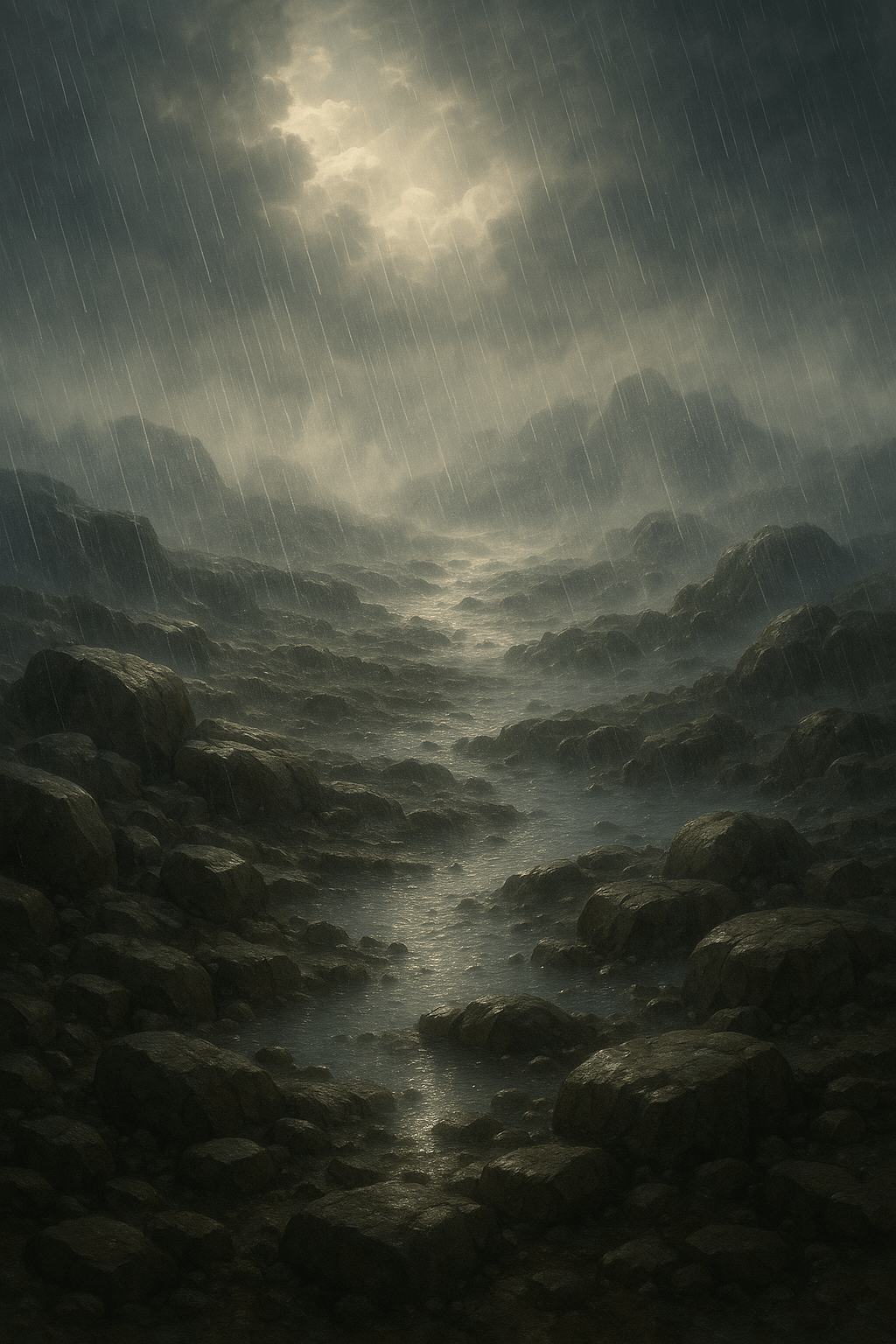
It rained for centuries. Then millennia. It rained so long the land forgot the sun. Not a drizzle or a downpour, but a steady, endless falling — warm at first, then cold, then colder still. Drop by drop, the sky returned what the Earth had buried. The atmosphere, thick with volcanic vapor and cosmic moisture, began to cool. Heat escaped into space, and as surface temperatures dropped, water vapor condensed into towering banks of cloud. These clouds, massive and unbroken, blanketed the planet and collapsed under their own weight. Gravity pulled the first rain down — not in storms, but in sheets — thick, unrelenting, and transformative.
Much of this water came from within. The volcanic breath that once choked the skies had carried water vapor upward for millions of years. But not all of it came from Earth. During a violent period known as the Late Heavy Bombardment, icy asteroids and comets — flung in from the cold outer reaches of the solar system — struck the planet in relentless waves. Many of these bodies were rich in water, locked as ice or hydrated minerals. Upon impact, some of this ice vaporized instantly, boiling into steam. Some penetrated the crust and slowly released their contents into the surrounding rock. Others, shattered and spread across the surface, left behind water that mixed with the thick, humid air. This cosmic water, delivered by fire and fury, mingled with Earth’s own breath and became part of the endless rain.
At first, the water struck bare rock. It hissed and steamed, evaporating into the heavy air. But Earth was cooling. Eventually, the surface stayed wet. The lowlands filled. Basins deepened. Pools became lakes. Lakes became seas. The seas grew wider and deeper until they became something else entirely — the first oceans.
They were not calm. They boiled. They surged with chemical storms. Rainfall fed them constantly, and runoff brought minerals down from the land, salting the water with every passing stream. The oceans were shaped by heat, by gravity, by wind — but mostly by time.
And with them, something new was born: motion.
The moment the first puddles gathered and the first drops ran downhill, gravity began to shape the future. Water did not stay where it landed. It moved. It carved channels in rock, wore away cliffs, and broke boulders into sand. It seeped into cracks and froze, prying stone apart. It gathered in hollows and built rivers that sliced through ancient plains. Over time, water redrew the face of the planet — not with violence, but with persistence. Even wind and weather followed its lead, as the evaporation and condensation of moisture began to steer atmospheric currents and birth storms. Then, warmed again by the young Sun, that same water rose back into the air as vapor — to begin again.
Evaporation. Condensation. Precipitation. Runoff. The hydrological cycle was born. Not as a storm or a flood, but as a quiet, self-sustaining pattern. The heat of the Sun drove vapor upward. Atmospheric currents carried it far. Clouds formed, and when they thickened, rain returned. Water flowed back to the oceans — or into the ground — and the process began again.
The oceans were not just a place. All water — in rivers, clouds, glaciers, and vapor — became part of a rhythm. A beating pulse that linked sky to stone, heat to cold, sea to soil. The water cycle was not merely oceanic; it was planetary, touching every surface, shaping every valley, feeding every storm. It stitched together Earth’s systems with motion, memory, and return.
Water is not only a liquid. It is a sculptor, a traveler, a memory. One that never ends.
It is the breath between sky and stone — the quiet balance that keeps the world alive.
Pathfinder
 Project Pathfinder
Leave a comment