
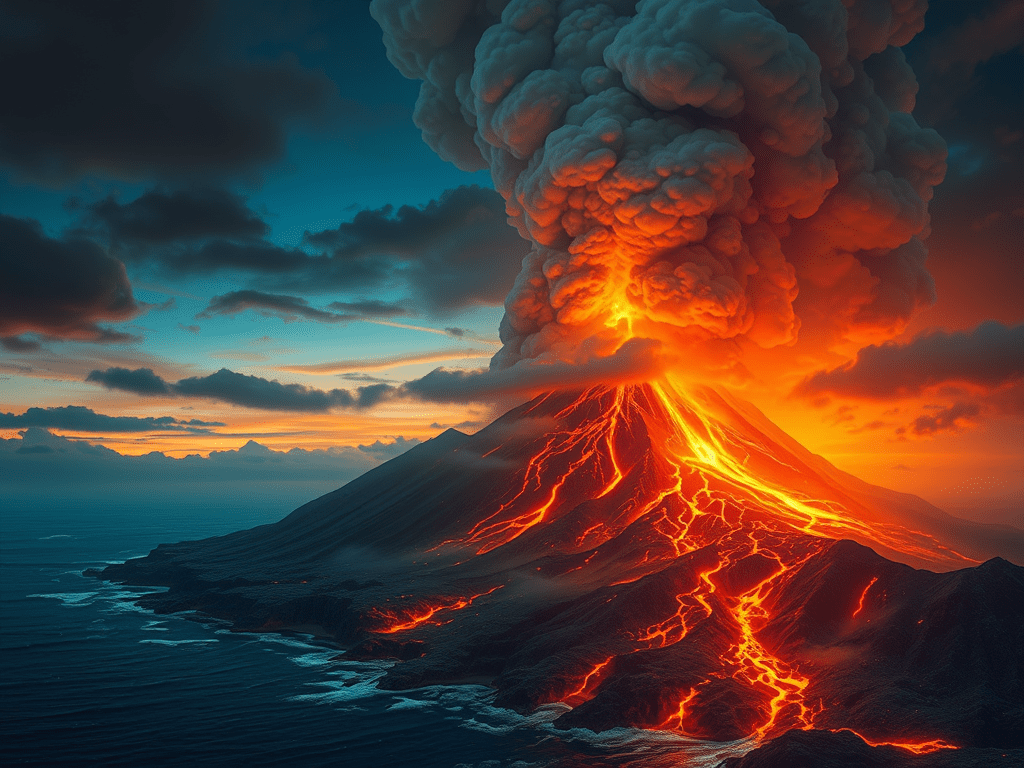
Event: Volcanic Formation and Influence
Date: ~3.8 billion years ago – present
“Fire, in the hands of nature, is both a sculptor and a destroyer.”
– John McPhee
Dear Human,
Volcanoes are the planet’s fiery vents, born from the movement of tectonic plates and the deep heat that stirs beneath the crust. They emerge along subduction zones, where one plate dives beneath another and melts into magma that rises to the surface in arcs and chains like those of the Pacific Ring of Fire, home to some of the most powerful eruptions in history. They form along rifts, where plates pull apart and molten rock wells up to create new crust, as in Iceland’s volcanic landscapes where fire meets ice. And they erupt far from plate boundaries, above hotspots — fixed plumes of heat from deep within the mantle — forging island chains such as Hawaii. Here, a single stationary hotspot has burned through the moving Pacific Plate for millions of years, creating a trail of volcanic islands and seamounts. As the crust drifts over this mantle plume at a pace of only centimeters per year, new volcanoes are born in sequence while older ones grow dormant and erode, their peaks still rising from the ocean floor as monuments to the planet’s patient, fiery artistry.
Not all volcanoes are the same. Stratovolcanoes rise steep and imposing, layered by alternating eruptions of ash and lava, their explosive power capable of burying landscapes and reshaping entire regions. Shield volcanoes spread in broad, gentle slopes, built by fluid basaltic lava that can travel great distances, forming vast plateaus and islands. Cinder cones, small but fierce, are built from molten fragments that cool in the air and fall back to Earth, piling into steep, short-lived cones often clustered around larger volcanoes. These types are variations on the same deep forces, sculpting and reshaping the surface over geologic time.
Volcanoes create new lands from the sea, building islands and altering coastlines within a human lifetime. Some eruptions, like Krakatoa in 1883 or Tambora in 1815, changed global climate for years, their ash and aerosols veiling the Sun and bringing cooling to the world. Their lava flows and ash deposits release minerals that enrich soils, sparking blooms of life where none existed before — as on the fertile slopes of Vesuvius or the regenerating flanks of Mount St. Helens. In this way, volcanoes are both destroyers and givers, burning and burying yet also laying the foundations for renewal.
To human cultures, volcanoes have always been more than geologic events — they are living powers. The Hawaiians speak of Pele, goddess of fire, shaping the islands with her lava. The Romans honored Vulcan, the divine smith, whose forge burned beneath mountains. In many traditions, volcanoes are the breath of the Earth itself — reminders of forces beyond human control, yet essential to the world’s making.
Stand before a volcano, and you feel the connection between the molten heart of the Earth and the life that walks its surface — a bond forged in heat and ash. Here, creation and destruction are inseparable: the same eruption that buries valleys can also birth new lands and fertile soils. These fiery mountains are not relics of the past but living engines of change, each eruption a heartbeat in the long rhythm of geological time, shaping the world anew even as they erase what came before.
Pathfinder
 Project Pathfinder
Leave a comment