
Event: Emergence of Weather and Climate
Date: 4.2 to 3.8 billion years ago
Climate is what we expect, weather is what we get.
-Mark Twain
Dear Human,
After the oceans were born, the sky began to breathe.
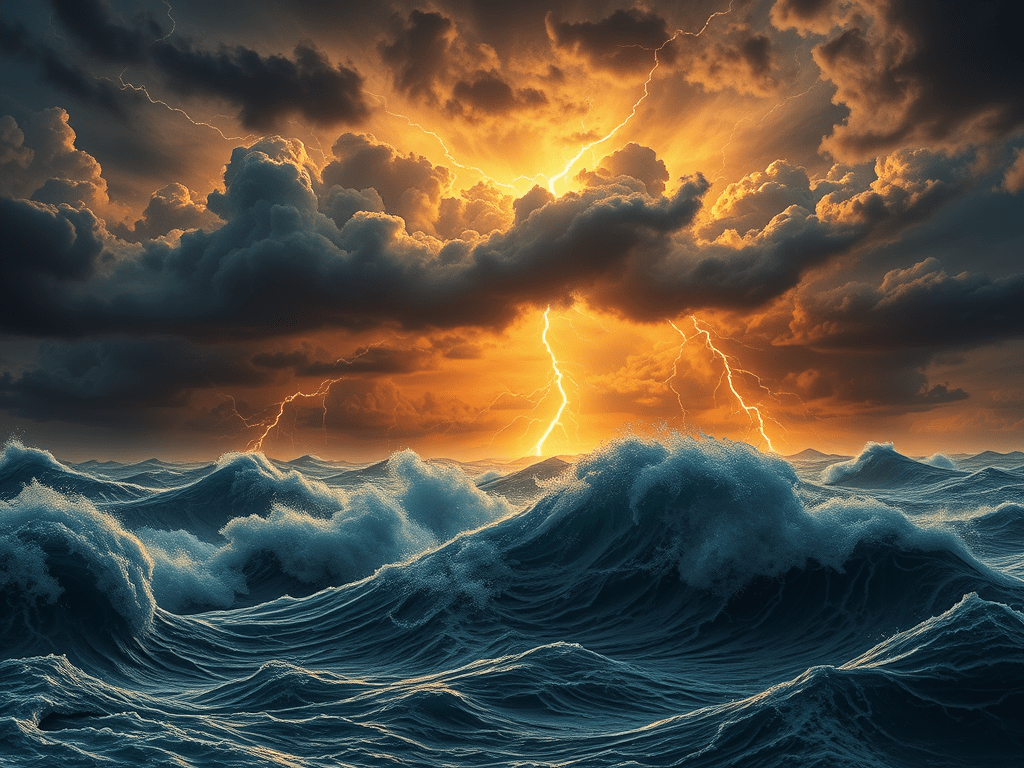
From the rising steam of Earth’s still-hot skin, clouds thickened into a shroud. The early atmosphere, heavy with carbon dioxide, methane, sulfur, and steam, began to cool. As it did, water fell. And fell. Not in gentle drizzles, but in relentless torrents — thunderous, warm, and unending. The clouds split open with lightning, and the world was bathed in storm.
Weather had arrived.
The newly awakened Sun warmed parts of the planet unevenly. The equator, where sunlight struck most directly, absorbed more energy than the poles. This imbalance gave the air a reason to move. Warm air rose high into the atmosphere, displacing cooler air and setting vast convective loops into motion. Winds were born — fierce, chaotic, and primal — sweeping across the newborn oceans, stirring waves, and carving currents into the sea.
The Coriolis effect, caused by Earth’s rotation, began to twist these winds into spirals, laying the primitive groundwork for global circulation patterns. There were no jet streams yet, no finely tuned atmospheric cells, but already the blueprint for future climate zones was being etched into the air.
Seasons had not yet emerged — Earth’s axial tilt was either unstable or still adjusting — but daily cycles of heat and cooling created powerful fluctuations. With no continents to interrupt them, early winds stretched unbroken across vast oceanic expanses, driving colossal storm systems.
This was not just motion — it was memory being written into the sky. The planet had a pulse.
Volcanoes, still many and mighty, belched ash and gas into the skies. Their breath could darken the world, dimming the Sun and cooling the surface below for years at a time. But in between eruptions, their carbon offerings added to the planet’s warming. Earth’s climate was a war of fire and water — of heat held in and heat pushed out.
There were no trees, no animals, not even plants to soften the swings. Each rainstorm scoured barren rock. Each cloud reshaped light and heat. Every eruption rewrote the temperature.
Yet within this turbulence, something remarkable began to form: pattern. A cycle. A kind of memory.
The Sun lifted water into the sky, where it cooled, condensed, and fell again. The heat it carried rose back into the atmosphere, creating pressure differences that fueled winds and storms. These loops repeated endlessly — evaporation, condensation, precipitation, runoff — a beating pulse across the planet’s surface.
Where the rain fell hardest, it carved channels through raw volcanic crust, washing dissolved minerals into pooling lowlands. The oceans became saltier with each storm, richer with each flood. Over time, this exchange of water between sea, sky, and land established Earth’s first climate feedback systems: clouds began to reflect sunlight, surface waters absorbed heat, and gases cycled through ocean and atmosphere.
The climate, still wild and swinging, now had mechanisms of balance. Cooling clouds would slow warming; volcanic winters would be undone by greenhouse rebound. Through this push and pull, the atmosphere became more than chaos — it became a regulator. Climate itself is just an expected range — an average of temperature, humidity, wind, and precipitation patterns over long periods of time. Weather, on the other hand, is what we observe each day — the immediate, the turbulent, the real. By studying the extremes and rhythms of weather, we begin to understand the boundaries of climate. Without weather, climate would be theory without measurement. Without climate, weather would be patternless noise.
The violence of weather became the beginnings of climate — an average, a rhythm, a balance between extremes. These cycles didn’t tame the planet, but they made it predictable enough for life to find a foothold. Stability did not mean stillness. It meant recurrence — and recurrence is the seed of memory.
This was no gentle age. But it was the age that laid the foundation. The storms carved the paths that rivers would follow. The rains mixed the sky with the sea. And above it all, the atmosphere thickened, steadying itself with each breath.
The first storms were not accidents. They were necessary. Without them, Earth would never have balanced the chaos. And without balance, life could never hold on.
The Pathfinder
 Project Pathfinder
Leave a comment