
Event: Planetary Erosion and the Birth of New Rocks
Date: Ongoing since ~4.0 billion years ago
“The progressive changes in the Earth’s surface are as much a part of the present system as any other phenomenon.” —James Hutton
Dear Human,
Imagine a world without erosion and decay.
Mountains would rise and never fall, their flanks sharp and barren, untouched by the softening hands of rain and wind. There would be no soil — only naked rock, hard and unbroken beneath your feet. Rivers, if they formed at all, would run clear but empty, carrying no nutrients to the seas. Forests would have no place to take root, grasses no ground to bind, crops no earth to grow in.
Life might still exist, but it would cling thinly to the edges of this unchanging crust — sparse mats of microbes in shallow waters, perhaps a few hardy lichens on stone. Without these breaking forces, the minerals locked in bedrock would never reach the surface to feed plants, and without plants, animals like us could never have come to be. Earth would be a still world, fixed and silent, a place without the patient artistry of change.
But our Earth is not still.
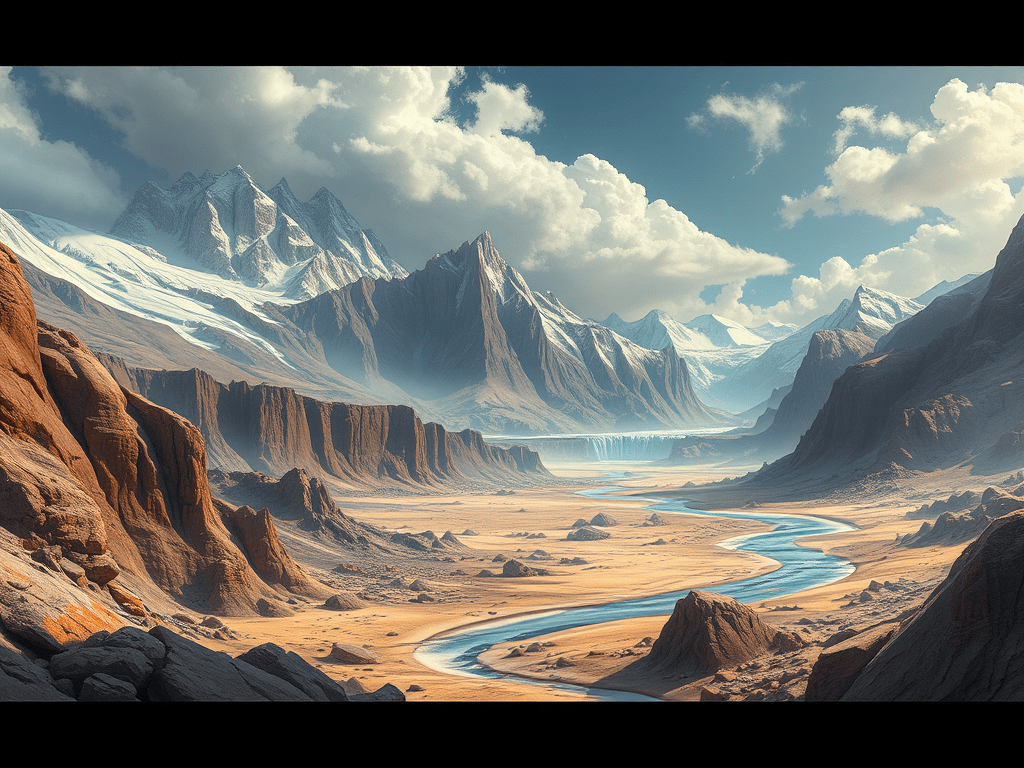
Wind, water, ice, and time take the edges from stone, breaking it apart, feeding the soil, and sculpting valleys, cliffs, and shores over ages. This is mechanical erosion — the work of force, pressure, and friction, prying rock into smaller and smaller fragments without altering its mineral makeup. Glaciers carve deep U-shaped valleys and polish bedrock beneath their frozen weight. Rivers grind stones to sand as they tumble downstream, carrying away entire hillsides grain by grain. Desert winds, laden with fine grit, patiently sandblast sheer faces into arches, spires, and sweeping curves, turning even the most stubborn bones of the land into new forms.
Chemical decay is slower, quieter, but no less relentless — a silent alchemy working at the surface of every exposed stone. Rainwater, laced with the faint acidity of dissolved carbon dioxide, seeps into fractures and pore spaces, eating into limestone and marble until entire caverns bloom in the dark and jagged towers rise in open air. In warm, moist climates, this process carves dramatic karst landscapes riddled with sinkholes and underground rivers. Oxygen reacts with iron-rich minerals, staining the ground in earthy reds and oranges as they crumble to rust. Water binds with feldspar to form soft clay, weakening the rock until hillsides slump and fall away, a transformation that begins in a droplet, works particle by particle, and may end in a landslide.
All that is broken is carried away, set adrift on slow journeys that can span continents and millennia. Rivers and streams shoulder grains and pebbles, grinding them smooth as they travel, and deposit them in broad, fertile deltas or along winding floodplains that shift with each flood season. The sea takes its share, pulling silt and sand into its depths and tucking sediment into patient layers that will one day harden into rock. Wind gathers the dust of ancient cliffs and builds vast dunes, sculpting ripples and crests that migrate across deserts. Glaciers, in their ponderous advance, spread debris in sprawling blankets called moraines, leaving behind jumbled fields of boulders and gravel when they retreat. Every grain has a journey — a slow odyssey from its birth in mountain stone to its rest in ocean floor mud, where it may sleep for ages before being called back into the cycle.
In time, the immense weight of overlying layers and the slow squeeze of geological time bind loose sediment into sedimentary rock — sandstone with its coarse grains from ancient beaches, shale born of fine mud from long-vanished seas, and, much later in Earth’s history after life emerged, limestone built from the shells and skeletons of countless marine creatures. Each layer is a chapter of history pressed flat, holding whispers of the world that formed it. When heat and pressure rise higher still, deep within mountain roots or at tectonic boundaries, these rocks are transformed into metamorphic rock — marble with a crystalline shimmer from limestone, slate with its clean split from shale, schist with its glittering mica from granite. And when molten rock wells up from the mantle and cools, whether crystallizing slowly beneath the surface as igneous granite or erupting and solidifying in the open air as dark basalt, the cycle begins anew, ready to carve fresh pages in Earth’s stone-bound chronicle.
This is the rock cycle: endless change in form, never in substance. What we call permanence is simply the pace of change too slow for us to see. But look closely — in a crack that widens each winter, in a river’s murky flood, in a pebble smooth enough to skip — and you will see the sculptors at work.
We live on a world forever in the hands of wind, water, ice, and fire. They shape the ground we walk, the cliffs we admire, the soils that feed us. And they will keep shaping, long after our footprints are gone.
Pathfinder
 Project Pathfinder
Leave a comment