
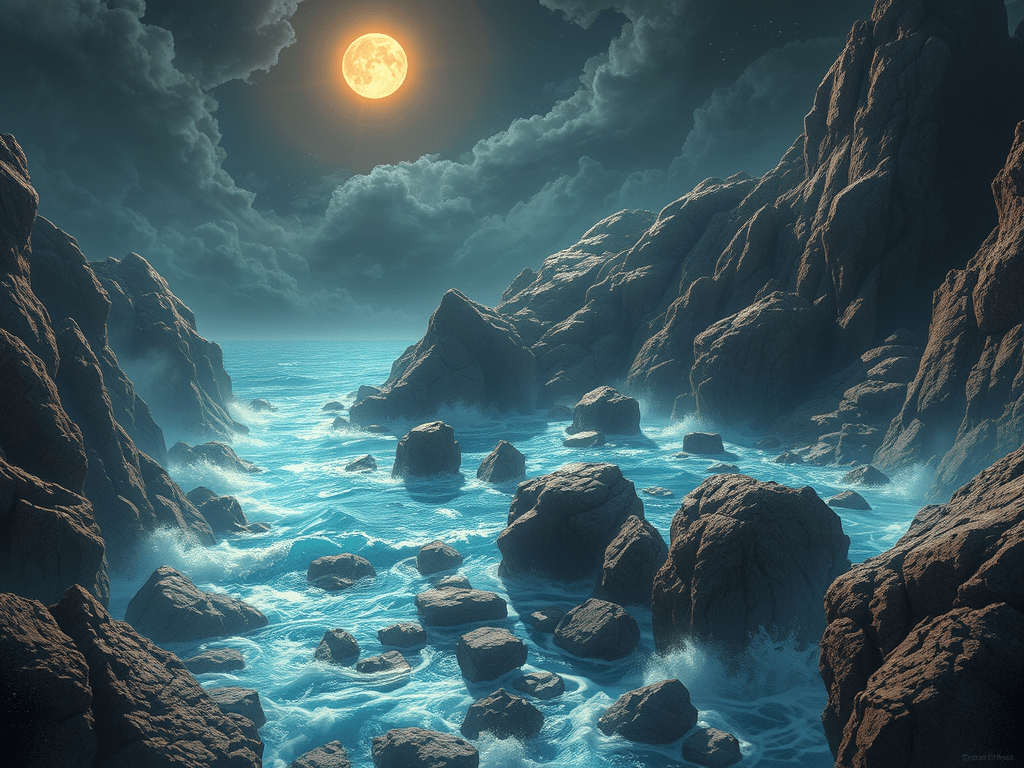
Event: The Early Carbon Cycle
Date: ~4.0 to 2.5 billion years ago
“Carbon is the element of life. Without it, we are but dust.”
–Jacob Bronowski
Dear Human,
Your world has always breathed, though not as you do. Long before forests and lungs, before bones and blood, the Earth’s respiration was written in stone and sky. Carbon moved in a slow rhythm between volcanoes, oceans, and weathering rocks. This cycle—this dance of air and stone—helped keep the fragile balance of warmth and cold, shaping the conditions that would cradle life.
The Sun that shone upon early Earth was weaker, only about seventy percent as bright as the one you know today. By reason alone, the oceans should have frozen solid, smothering the young world in silence. Yet the seas did not turn to ice. Volcanoes poured out gases from the planet’s depths, surrounding Earth with veils of carbon dioxide. This carbon dioxide acted as a greenhouse blanket, trapping heat close to the surface and preventing it from escaping back into space. In doing so, it kept the oceans liquid despite the dim star, transforming a faint trickle of sunlight into enough warmth to sustain a world of open seas. Without these gases, Earth’s oceans would have been locked beneath miles of ice. This greenhouse effect was Earth’s first great climate regulator, a natural mechanism that held the line against a frozen world and kept the planet within the narrow bounds of habitability.
Rain fell, drop by drop, carrying the breath of the sky into the bones of the land. As water touched rock, it drew carbon from the stone and carried it into rivers and seas. There, the carbon was hidden away in sediments, forming early layers of carbonate minerals on the ocean floor. These accumulations were modest at first, but in later ages, when life joined the process, vast beds of limestone and dolomite would grow. Some of these deposits built up into vast continental shelves, silent archives of the atmosphere. But the Earth is never still. Over ages, the crust fractured and sank, carrying these buried stores back into the deep, where fire and pressure released them once more to the air through volcanic breath. This steady recycling also buffered the chemistry of the oceans, moderating acidity and influencing the supply of key minerals, though conditions still varied from place to place. In this way, the carbon cycle not only shaped the air above but the waters below, ensuring oceans remained habitable long before life stirred within them.
This cycle was slow, yet steady, and it began hundreds of millions of years before life itself arose. When the air grew heavy with carbon, warmth sped the weathering of rock, drawing carbon downward into stone and sea. When the air grew thin, volcanoes replenished it, warding off a frozen silence. Over countless ages, this tug-of-war formed a feedback loop—not from intention, but from the natural laws of chemistry and geology. And still, its rhythm gave the impression of design: a planetary heartbeat, binding atmosphere, ocean, and crust together, keeping Earth alive and preparing the conditions for life’s own breath to one day join the dance.
The story of carbon does not end with rock and air. Carbon’s unique bonds allow it to form chains, rings, and frameworks, giving rise to the complexity of organic molecules. In this way, the same element that cycled through stone and sea became the backbone of proteins, sugars, and nucleic acids. Without this foundation, life as you know it—life based on carbon—could not have emerged. The geological dance prepared not only a stable climate, but the very chemistry of living flesh and breath.
And here lies the deeper truth: such balance arose through chance and alignment. This was the contrast that set Earth apart from its neighbors, a rare harmony struck where so many others failed to find it. Countless other worlds circle their stars without ever finding this balance, but Earth was fortunate that so many conditions fell into place to make it possible.
And yet it was also a possibility seeded from the moment of creation, when the Creator shaped a reality where rules of physics, chemistry, and geology allowed it—gravity to pull, thermodynamics to guide energy, atomic bonds to form and break, and the cycles of matter to emerge. These rules were neither random nor intentional in themselves, but they created a framework where such outcomes could naturally arise, not preordained yet always possible. In the bonds of molecules, in the patience of rain and stone, in the fire of the mantle—there lay the potential for stability. Earth did not choose its path, but the path was written into the fabric of existence itself. Without such laws, the world might have frozen and remained barren. With them, a breathing planet endured, preparing the way for life.
And when life finally appeared, it did not remain a passive passenger. Microbes learned to harvest carbon, exhaling new gases and altering the very air. In time, life would entwine itself with geology, reshaping the carbon cycle in return. Thus, the dance of air and stone became also the dance of life, each step echoing the rules written at creation. Life’s emergence, like the cycle itself, was not forced nor foreordained, but made possible by the same framework of laws. Within that possibility, biology found its footing, and the planet’s breath grew deeper and more intricate.
Pathfinder
 Project Pathfinder
Leave a comment