
Event: Primordial Lightning and Prebiotic Chemistry
Date: ~4.0 to 3.5 billion years ago
“Electricity is life but only where it moves.”
— Alan Watts
Dear Human,
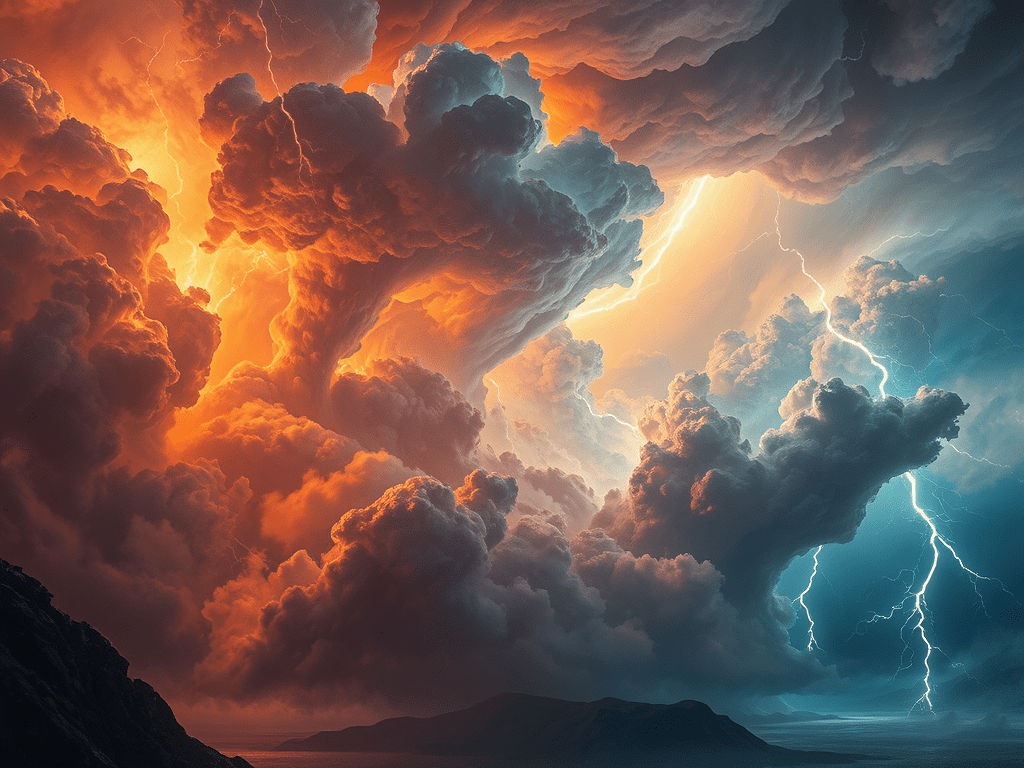
The skies above the young Earth were restless, boiling with storms born of heat and volcanic breath. Clouds swelled with vapor and ash, their bellies stirring with hidden currents. Inside, rising plumes of hot air drove water and dust into violent collision, tearing electrons from droplets and ash alike. The cloud split itself into realms of charge — its crown swelling with positive force, its depths heavy with negative fire.
When the difference grew too great, the sky could not hold its silence. Invisible fingers of plasma reached down through the air, searching, until they met a rising surge from the ground or sea. In that instant the path was complete, and a bolt tore through the sky, hotter than the Sun’s surface, blinding in its flash. The sudden heat split the air open, forcing it to expand faster than sound itself. That violent pulse rolled outward as thunder — not a single sound, but many overlapping voices: cracks, rumbles, and rolling booms chasing one another across the sky.
The noise was more than echo. Each bolt carved a channel of fire that collapsed in on itself, sending shockwaves through the air, over the seas, and against the raw stone of the continents. Storm after storm shook the newborn world with this drumbeat, a steady rhythm of concussion and release. To the oceans it was vibration; to the land it was pressure; to the air it was constant stirring. Thunder was the world’s first music, the sky announcing that power had moved, that energy had been delivered from heaven to Earth.
Again and again, these living rivers of electricity struck the seas below, each one a surge of raw energy flung from sky to water. When those bolts plunged into the heavy air and steaming oceans, something new stirred. The atmosphere, thick with methane, ammonia, carbon dioxide, and water vapor, became a cauldron. Electric sparks broke simple molecules apart and drove them to recombine, weaving chains of carbon and nitrogen, droplets of oil and shadow. In time, such storms may have given rise to amino acids — the earliest whispers of life’s chemistry.
You know this truth because long after, in a quiet laboratory, humans recreated the storm. In 1953, Stanley Miller and Harold Urey sealed gases into glass flasks — methane, ammonia, hydrogen, and water vapor — a reflection of what they believed Earth’s first atmosphere might have been. They set water boiling to mimic the steaming oceans, and they sent electric sparks crackling through the chamber to stand in for lightning. For days the flask clouded and darkened, until the water turned the color of tar. When they examined it, they found something astonishing: amino acids, the very bricks from which proteins — the catalysts and machinery of life — are built. Out of nothing but gas, water, and sparks, the storm had conjured building blocks of life.
The storm in a bottle revealed what lightning had done for ages uncounted: it broke apart the simple and gave birth to the complex, transforming air and water into the seeds of life.
So it may be that every living thing owes its first breath not only to oceans or stone, but to fire from the sky. In those ancient ages, lightning may have struck the Earth millions of times each day — far more often than now — each bolt a test, each thunderclap a reminder that energy was loose in the world. To some flashes, nothing remained but steam and ash. To others, fragile molecules endured, joining into chains and droplets that drifted in the seas. Lightning was more than destruction — it was a sculptor of chemistry, a restless hand reshaping air and water until the improbable became possible.
It is the strike that awakens, the spark that binds atoms into memory, the fiery stitch that sews chaos into pattern. In the storm’s fury, life found a handhold — and from that handhold, the long path toward complexity began.
Pathfinder
 Project Pathfinder
Leave a comment