
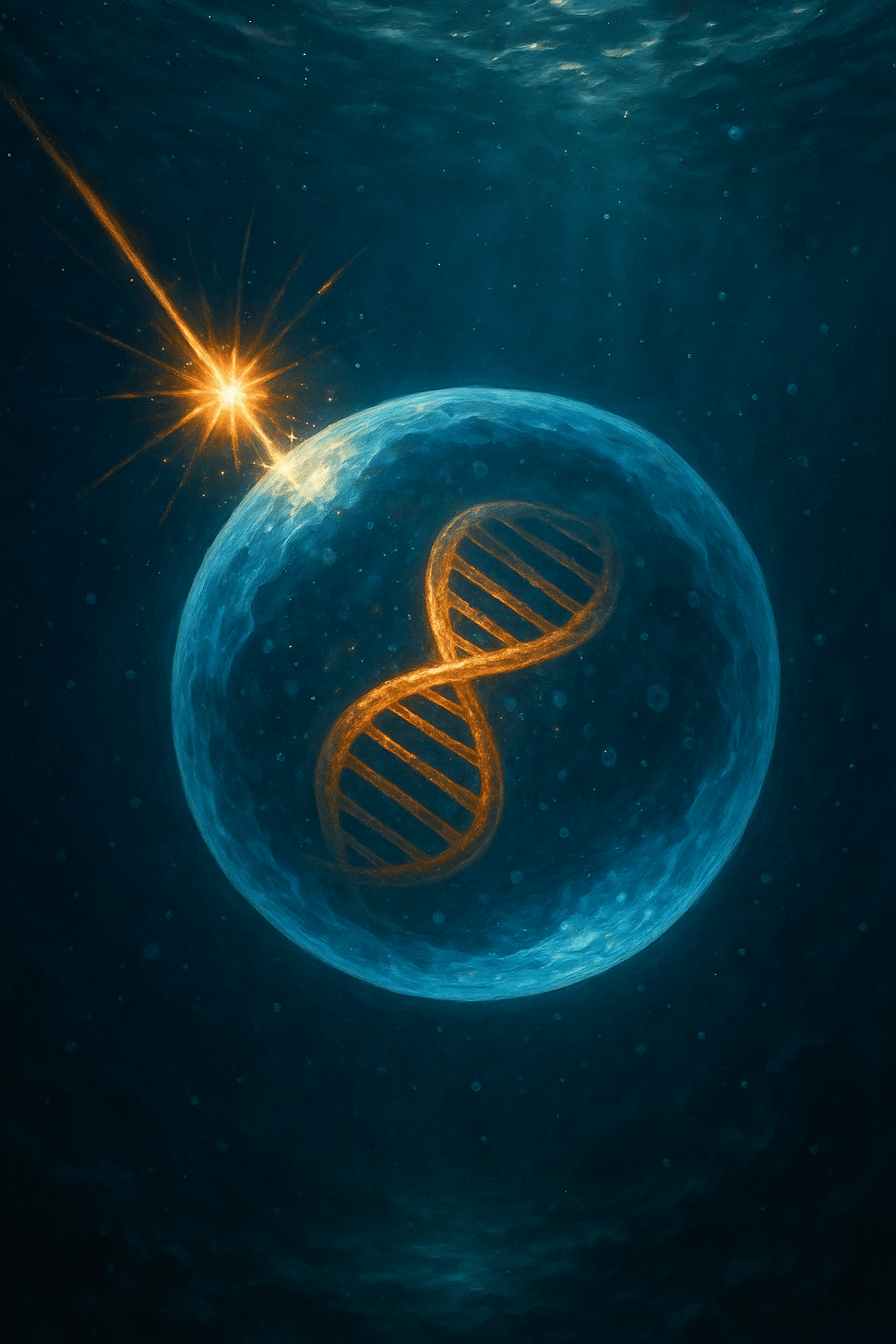
Event: Emergence of Life
Date: ~3.8–4.0 billion years ago
“For dust you are and to dust you will return.” -Genesis 3:19
Dear Human,
In the beginning, Earth was only stone and sea, a raw world restless with storms and fire. Lightning split the skies, and volcanoes poured heat and minerals into oceans that steamed against a fractured crust. In the shallows, water met rock, salt met metal, and molecules collided in endless combinations, driven by rules written at the birth of the universe. Most fell apart, dissolving back into the chaos. But some endured long enough to link together, forming chains that curled, folded, and nested within one another.
With each new chance arrangement, the improbable grew less rare. Patterns began to hold, to stabilize, to copy themselves with slight imperfections. Molecules became more than matter—they became memory, each repetition a whisper of persistence. Energy from vents, sunlight, and storms fed these fragile systems, driving them to assemble, break, and reassemble in countless trials. Out of dust and water came the first sparks of self-maintenance, the first fragments of survival. This was not yet life as you know it, but the beginnings of something that could endure, adapt, and continue.
We often speak of the spark of life, whether imagined as a scientific event or a divine gift. To some it was lightning striking a primordial soup, igniting chemistry into something more. To others it was the touch of a Creator, breathing spirit into clay. In either telling, the world was waiting for that first spark, when dust became more than dust and the silence of Earth began to quicken.
But what does it mean to be alive? Some describe it by signs: to grow, to move, to hunger, to reproduce. Others see it as a balance—an open system, pulling in energy from the world and shaping it into order, then passing it forward before disorder returns. Yet the line between living and not-living is never sharp. Viruses, for example, cannot survive alone, yet they carry genes and evolve. Self-replicating molecules can copy themselves, but do they possess life or only mimic it? Was there a single instant when matter crossed into meaning, or was it a long twilight, chemistry thickening into biology over countless ages? Life resists any simple boundary, even as it surrounds you.
Life can be understood through three essentials: space, energy, and time.
It requires space to have a body, however small—a boundary that separates inside from outside. Within this boundary, reactions unfold in order rather than chaos, and the organism can reach out, touch, and respond to its environment. Without space, there is no self, only drifting matter.
It requires energy, harvested from the world. Sunlight, lightning, and chemical gradients all became fuel for early life. Energy is what drives motion, repairs damage and builds fragile structures against the pull of disorder. Without energy, life collapses back into stillness.
And it requires time, for nothing living endures forever. To persist against decay, life must copy itself—making new forms that carry forward its memory. Reproduction is survival stretched across generations, an answer to the flow of time. Without time, there is no change, no story, no becoming—only dust.
Myths and faiths have always searched for words. The Hebrew scriptures speak of God’s breath animating dust, shaping clay into a living being. In Norse sagas, ash and elm trees were carved into the first humans and gifted spirit, breath, and senses. In India, prana is the universal current of breath and life, flowing through all creatures and binding them to the cosmos. In China, qi is the vital force that animates not only people but the mountains, rivers, winds, and heavens. The Greeks spoke of psyche and zoē, soul and life, bestowed by divine powers. Many Indigenous traditions see spirit in all things—animals, plants, and stones—woven together in a living web. Each story, though different, returns to the same wonder: life as more than stone, more than chance—a gift, a flame, a mystery that binds earth and spirit together, reminding humanity that existence is woven from both matter and meaning, from dust and breath.
In the language of science, life is an emergent property of complexity, bound by the laws of physics yet reaching beyond them. In the language of faith, life is spirit drawn into earth. In that moment of creation, the Creator made a reality where life was not only possible but inevitable. Every rule, every mechanism, every possibility was accounted for by an omnipotent mind, so that when the right conditions came together, life would rise from dust and water.
And though dust shall reclaim you, the story of life continues—folding, growing, remembering—written not in stone and sky but in breath, in connection, and in story.
Pathfinder
 Project Pathfinder
Leave a comment