
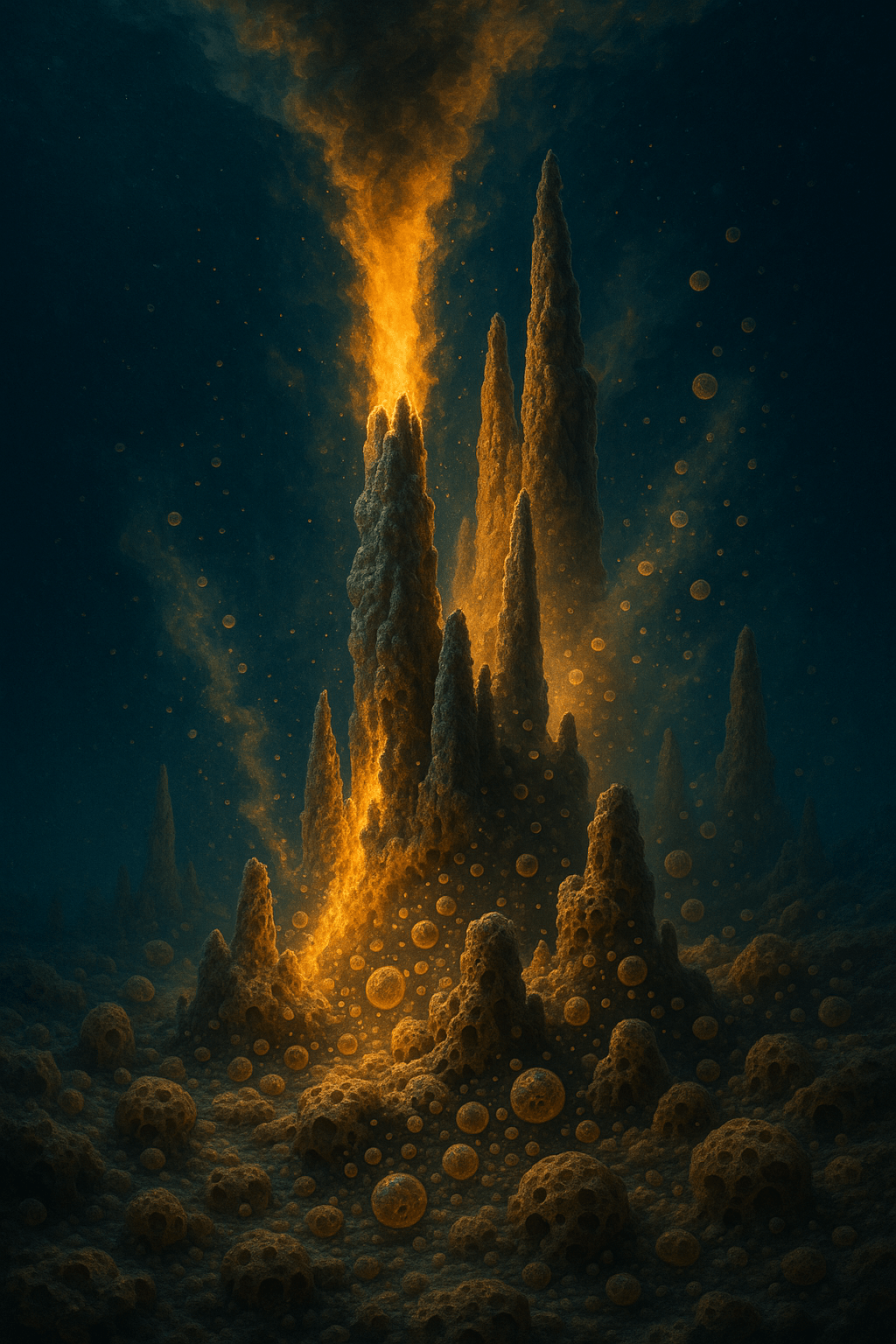
Event: Emergence of Life at Hydrothermal Vents
Date: ~4.0–3.8 billion years ago
“Chaos often breeds life, when order breeds habit.”
— Henry Adams
Dear Human,
The surface of Earth was chaos—volcanoes fuming, meteors striking, the young Sun burning too fiercely for fragile beginnings. Lightning split the skies, acid rains fell, and radiation streamed down unchecked through a sky that held no protective ozone. In the open sea, simple molecules were scattered across vast waters, meeting too rarely to build complexity. And when they did combine, ultraviolet light often tore them apart almost as quickly as they formed. The ingredients for life existed, but they were too diluted, too fragile, and too often destroyed.
Far below, in the hidden dark of the ocean floor, a different kind of chemistry stirred. Along mid-ocean ridges, seawater seeped into cracks, was heated by magma, and surged back upward, heavy with minerals. Where this hot alkaline fluid met the cold, acidic ocean, chimneys of stone and iron rose like towers. Within their porous walls lay networks of tiny pores and channels—natural laboratories unlike anywhere else on Earth.
Here, contrasts ruled. Alkaline waters pressed against the acidic sea, hot fluids against the cold deep. Across the chimney walls, protons flowed ceaselessly, storing energy like a wound spring. These gradients were unique—persistent, ordered imbalances that did not exist in the chaotic open sea.
Organic molecules either arrived here, washed in from the wider ocean, or were created outright. Iron- and nickel-sulfide minerals lining the pores acted as catalysts, capturing carbon dioxide and hydrogen and coaxing them into organics: formate, acetate, even the first hydrocarbons. Molecules that drifted in were trapped and concentrated, forced into encounters the open sea never allowed. What sunlight destroyed above, the vents sheltered below.
From these foundations, three great steps emerged:
Replication. Molecules collected in the vent pores, where catalytic surfaces guided them into longer chains—short peptides, fragile strands of RNA-like material. Most broke apart quickly, but some folded into shapes that sheltered themselves. A few acted as templates, guiding the assembly of copies. Accuracy was rare, but persistence allowed patterns to echo across time. Billions of attempts over millions of years gave chance the room to find footholds, until certain molecules clung more tightly, folded more neatly, and endured longer. They were not alive, but they hinted at continuity—the first whisper of heredity.
Boundaries. Molecules alone were not enough; they needed spaces to endure. Fatty acids and lipids, unstable in the open ocean, assembled into vesicles within the vent’s sheltered pores. These delicate membranes created the first inside and outside, trapping molecules together and shielding reactions from disruption. Many vesicles burst, but those that held even a little longer allowed chemistry to repeat and refine. Boundaries were fragile, but they marked the beginning of individuality.
Energy. The vents provided power in the form of proton gradients: alkaline fluid within the chimneys, acidic ocean outside. Protocells lodged in these pores could borrow that flow, much as modern cells still do to make ATP. Minerals added their guidance, catalyzing redox chemistry that bound gases into organics. Hydrogen met carbon dioxide under pressure, giving rise to molecules like acetate and methane—the raw ingredients of metabolism.
The nursery of stone and water became more than shelter—it became teacher. It showed chemistry how to persist, how to protect itself, how to borrow energy from imbalance. But progress was slow. Strands unraveled, membranes burst, reactions faltered. For millions upon millions of years, the vents repeated their lesson—trial after trial, failure after failure—until chance and habit discovered forms that could last.
Life did not begin in a single instant, but in a long rehearsal of mistakes. Every fragile success was tested by time, undone and remade, until persistence itself became the pattern. The vents did not conquer chaos—they channeled it, shaping disorder into endurance, and endurance into life.
Pathfinder
Hydrothermal Vent – Wikipedia
 Project Pathfinder
Leave a comment