
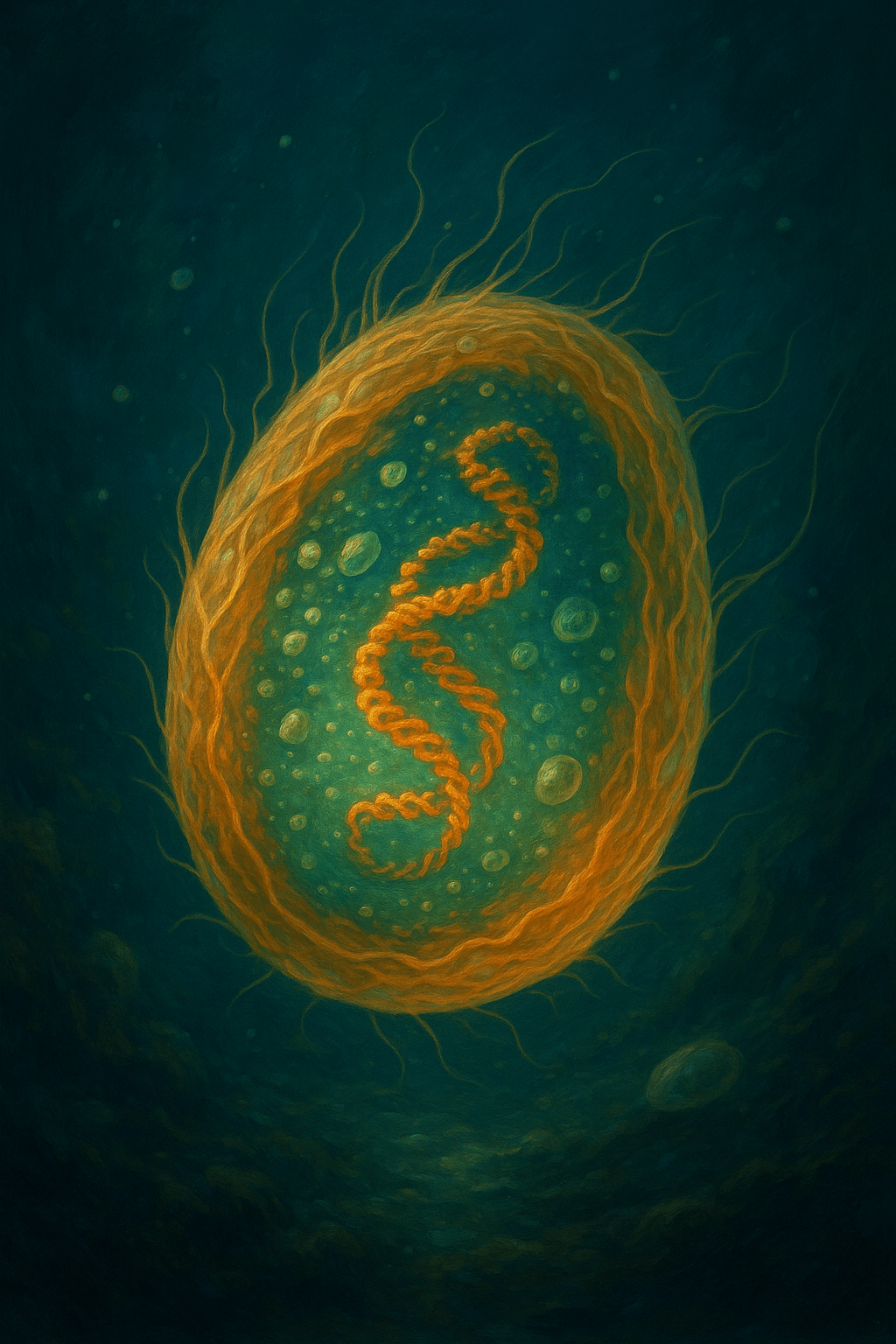
Event: Operation of Early Cells
Date: ~3.5 – 2.5 billion years ago
“What we call life is but a network of chemical reactions kept in balance.”
— Jacques Monod
Dear Human,
To glimpse the earliest cells is to glimpse the architecture of life itself. Each was no more than a fragile bubble, a boundary of lipids forming a thin, flexible wall. This membrane was their first defense, keeping the storms of the outside world at bay and protecting what mattered most within—the genetic instructions, the proteins, and the delicate chemistry that made life possible. Yet it was not sealed shut: small molecules crossed by diffusion, the movement of particles from high concentration to lower concentration, always seeking equilibrium. Like the way a scent spreads across a room until it is everywhere, diffusion carried nutrients inward and wastes outward, without effort, guided only by balance. Within this boundary, chemistry found shelter.
Inside lay the cytoplasm, a watery world thick with dissolved salts, sugars, and molecules, where countless reactions unfolded. Floating here was the most precious cargo: strands of genetic material, DNA or RNA, carrying the instructions for how to live, grow, and divide. These codes were not written in ink but in sequences of bases, a chemical alphabet that could be copied and passed on.
Beside them worked the ribosomes, ancient molecular machines built from RNA and protein. They read the genetic instructions and assembled proteins, one amino acid at a time, linking them into long chains. Each protein folded into a unique shape, becoming a tool with a specific purpose. Some acted as enzymes, speeding up chemical reactions. Others strengthened the membrane, carried signals, or built new molecules. In this way, proteins became the builders, the movers, the catalysts of life’s endless chemistry.
But structure alone was not enough. Every cell needed energy to power its machinery. Without fuel, the codes could not be read, proteins could not fold, and division could not occur. The first cells drew energy from the Earth’s minerals, using chemical reactions to release power from their surroundings—turning what the planet offered into nourishment. These reactions often involved elements like hydrogen, sulfur, and iron, transferring electrons and releasing usable energy. Unlike modern cells, which rely on oxygen-rich respiration, these early pathways were simpler and anaerobic, shaped by a world without free oxygen.
Inside the cell, that power was carried in small molecules like ATP, which acted like tiny batteries. Each could be charged with energy and then spent to drive the tasks of life—building proteins, repairing membranes, or moving a flagellum. When one battery was used up, another could be charged again.
Metabolism—these endless cycles of harvesting, storing, and spending energy—was the heartbeat of the early cell. It was not a single pathway but a web of chemical routes, some ancient and simple, others intricate and new. Together they allowed life not only to endure, but to adapt and spread across a restless world.
Movement was another secret. Some cells floated helplessly with the currents, carried where chance allowed. Others grew tails—flagella—that spun like tiny propellers, driving them toward richer waters, or away from danger. To move was to choose, and to choose was to survive.
When growth demanded it, the cell divided. Binary fission was simple: the genetic code copied, the membrane stretched, and the living bubble split in two. Like the passing of a flame from one candle to another, the spark of life was shared, ensuring continuity. Two daughters, nearly identical to their parent, carried the ancient design forward. Yet sometimes the copy was imperfect, and in that imperfection—mutation—new possibilities emerged.
Even in their simplicity, these early cells were astonishing engines of chemistry and resilience. They balanced structure and function, energy and reproduction, defense and exploration. From such modest beginnings, all the complexity of life unfolded. The architecture of life was laid, and it has endured for billions of years, reshaping itself yet never abandoning the simple wisdom of a boundary, a memory, and a spark of energy.
Pathfinder
 Project Pathfinder
Leave a comment