
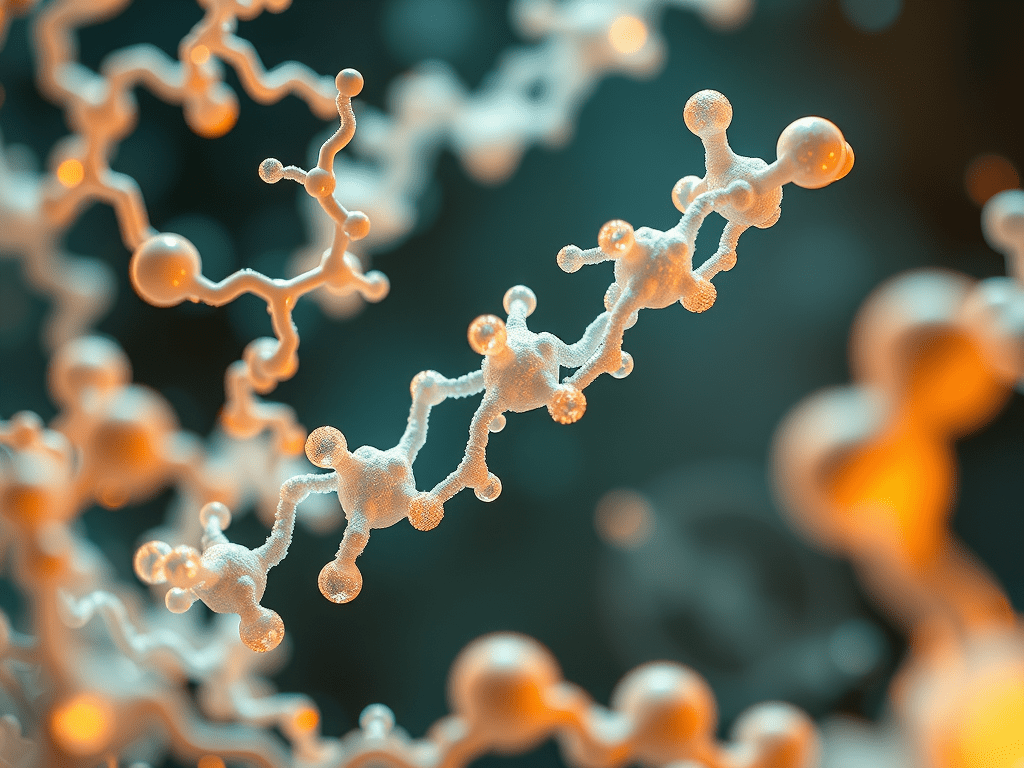
Event: Emergence of Proteins and Enzymes
Date: ~3.8–3.5 billion years ago | ~700–1,000 million years after Earth’s formation
“Life did not begin with molecules that copied themselves, but with molecules that learned to cooperate.”
— Harold Morowitz
Dear Human,
The first voices of life were not spoken — they were assembled. Inside the thin membranes of early cells, chemistry began to take form and purpose. DNA held the memory — long spirals of code storing every instruction life had learned to preserve. RNA became the interpreter, carrying those messages outward, translating the quiet archive into action. The ribosomes, built from the same restless strands, read the RNA’s script and drew in floating amino acids one by one, aligning them in precise order, linking them into chains with bonds of carbon and nitrogen. Each link was chosen according to sequence, each sequence a message written in matter.
When the chain was complete, it folded in on itself — drawn together by invisible forces that governed every motion of existence. Each amino acid carried its own nature: some reached for water, others fled from it; some held electric charge, others none at all. The molecule twisted and coiled, seeking the single shape where every attraction and repulsion found balance — the lowest energy, the point of peace.
That shape was no accident. It was written into the sequence itself. The same chain of amino acids would always find the same fold, as surely as a melody finds its rhythm. Each bond locked into place in the span of a breath, forming loops, pockets, and grooves exactly where they belonged. From this inevitability came precision — and from precision, power.
In that form lay its purpose. A pocket that fit sugar would always fit sugar. A cleft that held metal would always hold metal. The protein’s shape determined its behavior, and through that shape, chemistry learned discipline.
But sometimes the message faltered. A single misplaced amino acid, a broken sequence, and the fold would collapse into confusion. The protein would twist into knots, clump into useless tangles, or refuse to form at all. A misfolded enzyme could no longer catalyze its reaction; a broken structure meant silence in the language of the cell. For early life, such mistakes were ruin — chemistry without comprehension.
Yet failure was also instruction. Molecules that folded correctly survived to copy their pattern again. Those that didn’t vanished into the sea. Through this quiet, relentless selection, life refined itself — each success another word added to the growing vocabulary of existence.
From these perfect folds arose the enzymes — the first true craftsmen of life. Each was a shape built for purpose: a pocket perfectly fitted to the molecule it would serve. When a wandering substrate drifted near, it was drawn in by the enzyme’s contours, held in place just long enough for change to occur. Inside that hollow, bonds stretched and weakened, others tightened and snapped into new patterns. The enzyme lowered the wall of effort — what once demanded immense heat or time now happened with a whisper of energy.
Without them, chemistry waited. With them, chemistry moved. Enzymes turned slow reaction into rhythm, scattering sparks of creation through the ocean’s dark. Some joined molecules into chains; others broke them apart. Some captured the energy of sunlight or heat, storing it in phosphate bonds, while others released that energy in moments of need. Together they wove a circuit of reactions — one feeding the next, building what was lost, recycling what was broken.
This was metabolism: a living network of cause and renewal. Energy entered as sunlight, iron, or sulfur, transformed into motion and stored as chemical promise. Molecules such as ATP carried that promise, passing it from one enzyme to another like a lit torch in an endless relay. Within these cycles, life achieved its first balance. For every reaction that consumed, another restored. For every spark that built, another dismantled.
And still, evolution pressed onward. Enzymes that worked faster, held tighter, or wasted less energy began to dominate. Some linked together into vast pathways — hundreds of reactions running side by side, sharing intermediates like words passed through a crowd. Out of their cooperation came precision, and out of that precision, endurance.
They became the pulse of the planet’s new chemistry — the breath between creation and decay, the heartbeat beneath the water. Every protein, every enzyme, was a line of dialogue written in atoms — a code not spoken but performed. Bonds meant join. Folds meant hold. Cavities meant transform. Together, they formed the first grammar of life, where meaning was motion and structure was thought.
The chemistry of Earth had begun to speak — not to us, but to itself. And through that patient language, it learned the secret still written in your blood: that cooperation is creation, and that form is the mind made real.
Pathfinder
 Project Pathfinder
Leave a comment