
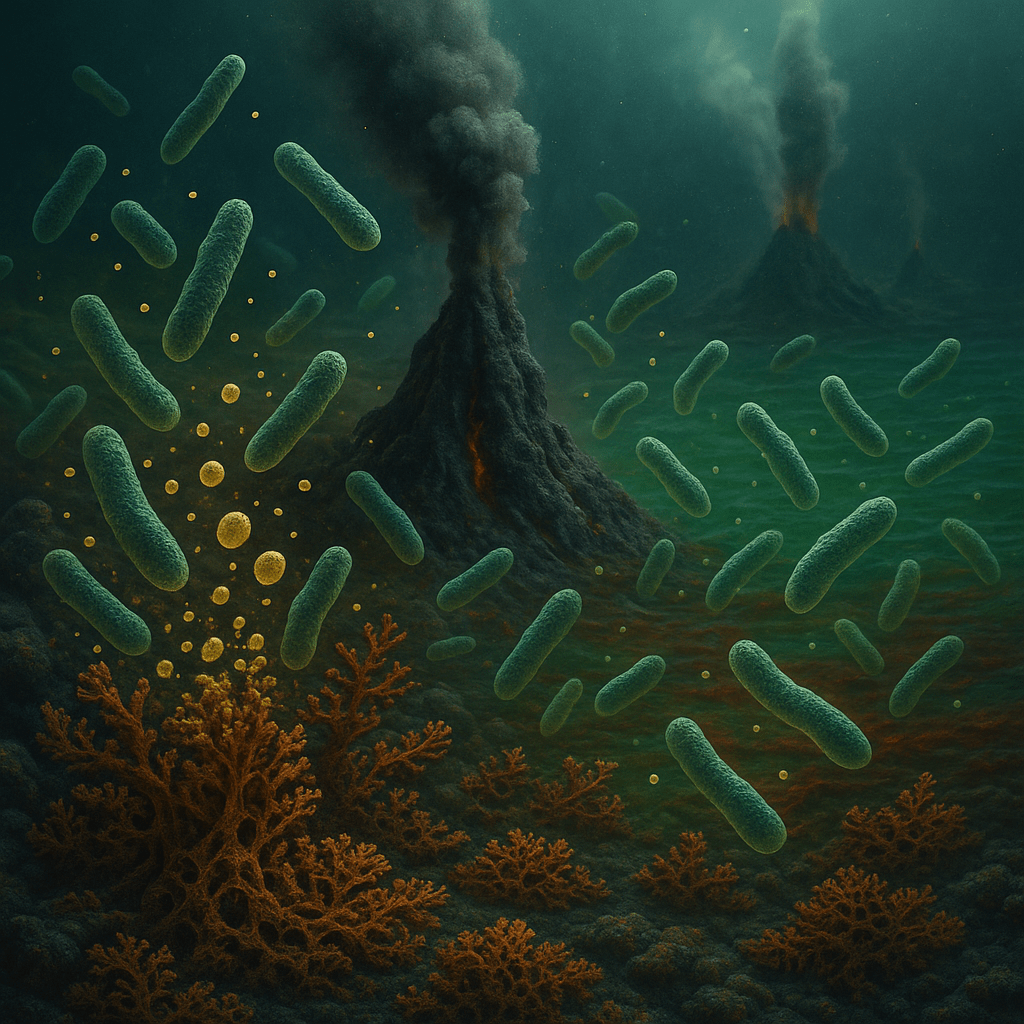
Event: Early microbes harvest energy and alter Earth’s chemistry
Date: ~3.5 to 2.5 billion years ago
“Life did not take over the globe by combat, but by networking.”
— Lynn Margulis
Dear Human,
Imagine a world where the seas were dark with iron and the air was heavy with strange gases. Into this hostile stage stepped the first microbes, unseen yet tireless. They discovered a way to tap into the planet’s hidden flows — not by fire or sunlight, but by leaning into chemical gradients. Where sulfur seeped, methane bubbled, and iron rusted, they found the spark of energy.
Some microbes fed on sulfur, taking in the foul breath of vents and leaving behind bright yellow grains. Others drew their strength from iron dissolved in the oceans, turning green waters slowly red with rust that drifted down and hardened into stone. Still others learned to split methane, a gas that rose in bubbles from the seafloor, and transformed it into energy and a trail of carbon. Each of these strategies was a form of chemosynthesis: making life out of imbalance, stitching order from the invisible pull between one chemical and another.
This was survival by shadow-work. Unlike photosynthesis — which would one day capture the brilliance of sunlight and flood the world with oxygen — these early reactions required no light at all. They did their work in darkness, altering the crust and chemistry of the seas quietly, grain by grain, tide by tide. Their efforts did not brighten the sky, but they prepared the stage upon which light could later act.
Their true genius, however, lay in their ability to share. Unlike later creatures, bound to pass traits only from parent to child, these early microbes could pass pieces of their DNA sideways. DNA was their memory — long chains of instructions written in the language of life. It carried recipes for survival: how to build a protein, how to draw energy from a mineral, how to endure heat or salt or acid.
Sometimes fragments of this memory escaped into the waters when a cell broke apart, waiting to be gathered and repurposed by another. Sometimes two microbes brushed together and exchanged strands directly, like neighbors trading tools. At other times, tiny couriers — viruses and other packets of DNA — ferried instructions from one cell to the next.
In this way, the library of life was not confined to bloodlines. A discovery made by one could become the inheritance of many. A new way to feed on sulfur, a trick for resisting toxins, a talent for clinging to stone — any of these could spread through an entire community in the space of days or years, instead of waiting for slow generations to stumble upon the same chance mutation.
Horizontal gene transfer turned survival into a collective act of storytelling. Each microbe was both an author and a reader, writing notes into the sea and borrowing the wisdom of others. DNA gave them memory, but sharing gave them resilience. This is how life learned to grow strong in a world that was still raw, restless, and unstable.
The evidence of their presence still lingers. In shallow seas, layer upon layer of microbial mats rose into knobby structures called stromatolites. These were living carpets, colonies trapping sediments and exhaling subtle chemistry into stone. Each band, built one atop another, is a memory of patient work, a diary of microbes carving their initials into the crust of the Earth. Even now, in rare corners of the world, stromatolites endure, whispering the persistence of those ancient architects.
Through these acts — pulling energy from gradients, sharing the secrets of survival, and etching their lives into stone — the first microbes began altering the surface and chemistry of Earth itself. What was once purely mineral became biological. What was once silent stone began to pulse with cycles of matter and energy. Slowly, invisibly, they started to change the sky above and the oceans below.
And remember this: the same DNA that leapt between those ancient cells still flows within you. Their memory became your memory, their survival became your inheritance. From the dark alchemy of their sharing came the possibility of forests, animals, and thought itself. In their silence, they began the story you are still writing today.
You may think of them as simple. Yet their legacy is profound: they were the first alchemists, turning the raw ingredients of the young Earth into the beginnings of a living world.
Pathfinder
 Project Pathfinder
Leave a comment