
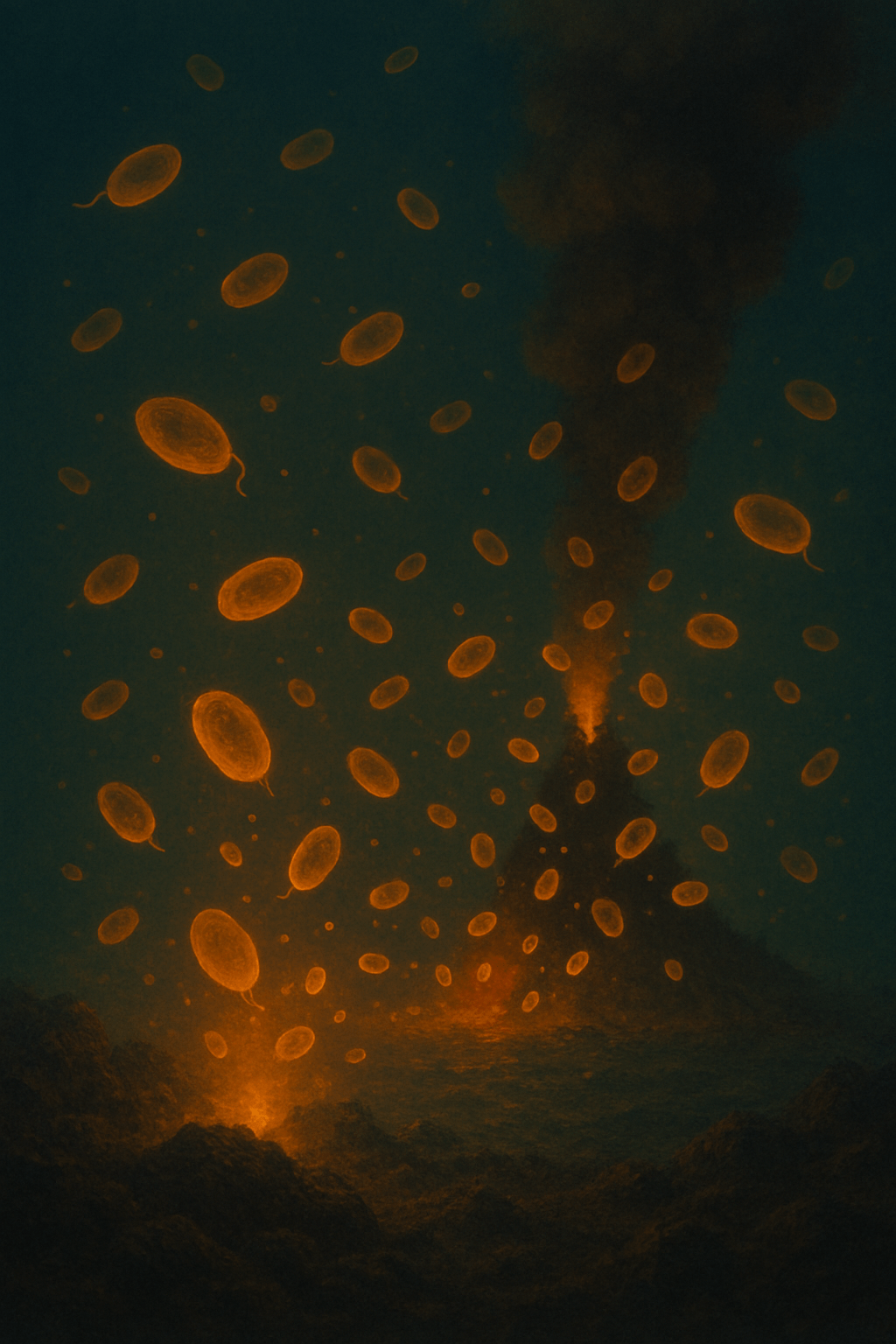
Event: Emergence of LUCA and the divergence into Bacteria and Archaea
Date: ~3.5 to 3.8 billion years ago
“We are not only related to every living thing — we are them, carried forward.”
— Lynn Margulis
Dear Human,
Every family begins with an ancestor. For all life on Earth, that ancestor is known only by a name: LUCA, the Last Universal Common Ancestor. We cannot see LUCA directly — no fossil, no preserved cell, only the faintest echoes in the shared code of its descendants.
LUCA was a mystery ancestor, simple yet powerful. It likely carried DNA for memory, RNA for translation, and proteins for work. It lived in a world of rock and water, perhaps near hydrothermal vents where energy surged up from the deep Earth. It had found a way to persist, to copy itself, and to hand forward the instructions of life. That persistence is why you exist at all.
From LUCA, the family tree began to branch. On one side arose the bacteria, masters of adaptability, endlessly inventive in the ways they harvest energy. They became wanderers of every environment — drifting in the open sea, clinging to rocks, burrowing in soil, and eventually finding homes inside other organisms.
Some bacteria became recyclers, breaking down dead matter into simpler elements so that life’s building blocks could be used again. Without them, the planet would choke on its own remains. Others became builders, laying down minerals, shaping soils, and altering the chemistry of their surroundings. Still others became innovators, discovering entirely new ways to live — including photosynthesis, a breakthrough that would one day flood the world with oxygen and open the path to more complex life.
Bacteria also became partners. They entered into alliances with other living things, sometimes as helpers, sometimes as parasites, but always as participants in the shared web of survival. In your own body, trillions of them live within your gut, skin, and mouth. They digest food you cannot, produce vitamins you need, train your immune system to recognize friend from foe, and may even influence your mood and health in ways science is only beginning to understand. You are, in truth, a walking community, carrying roughly as many bacterial cells as human ones.
Bacteria have endured because of this versatility. They can swap genes, form spores to survive drought or fire, and adapt within days to new threats. From the deepest ocean trench to the highest clouds in the sky, from the ice of Antarctica to the warmth of your skin, bacteria have never ceased expanding into new realms. They are LUCA’s restless heirs, proof of how one ancient ancestor’s spark could spread into uncountable forms.
On the other side arose the archaea, masters of extremes. They did not spread as widely as bacteria, but instead carved out kingdoms in places where almost nothing else could endure. They became the keepers of the edges — the scalding pools of volcanic springs, the salt flats where crystals glitter under the sun, the black smokers of the deep ocean where water gushes out hotter than boiling, and even the frozen soils of polar deserts.
At first glance they look like bacteria: tiny single-celled bodies without nuclei, invisible without a microscope. But beneath the surface they are built differently. Their membranes are stitched from unusual molecules that make them tougher, less fragile, able to resist heat, salt, and acid. Their enzymes are tuned to extremes, continuing their work even in conditions that would unravel the chemistry of other cells. To live where no one else can, archaea rewrote the rules of what a cell could be.
Their metabolisms are equally strange. Some archaea breathe methane in or out, shaping the gases of Earth’s early atmosphere. Others survive on hydrogen, sulfur, or metals, drawing energy from the raw elements of the planet. Some form hidden partnerships with other organisms, exchanging chemicals or balancing energy flows in ways that reveal their quiet role in Earth’s web of survival.
Though often overlooked, archaea are reminders of resilience. They show that life is not bound to comfort but thrives on challenge, pushing into realms of fire, ice, salt, and stone. For billions of years they have endured, changing little yet surviving everything. They are LUCA’s stubborn heirs, proof that even in the harshest corners of existence, life finds a way.
For billions of years these two lineages have carried LUCA’s memory forward. Their survival is proof of the strength of that original design — DNA for memory, proteins for work, and the ability to endure change. They diverged early, yet both flourished, shaping the oceans, the atmosphere, and the very surface of the Earth long before plants or animals appeared.
And here is the wonder: you are part of this family still. The bacteria that live within you are not strangers, but cousins from LUCA’s line. The archaea that persist in remote corners of the world are not relics, but kin who never left their chosen homes. Every breath you take, every cell in your body, carries the inheritance of that first ancestor. LUCA is lost to time, yet through its children it remains everywhere.
The first family has never ended. Its branches spread outward still — bacteria, archaea, and all that came after. What unites them is stronger than what divides them. All life is kin, and its story begins with a mystery we still carry within. Your DNA still carries fragments of that ancient script — traces of LUCA’s code written into every cell, binding you to life’s first ancestor. LUCA was the unseen root, and from it grew a million branches: bacteria, archaea, plants, animals, and you.
Pathfinder
Last Universal Common Ancestor – Wikipedia
Bacteria – Wikipedia
Archaea – Wikipedia
 Project Pathfinder
Leave a comment