
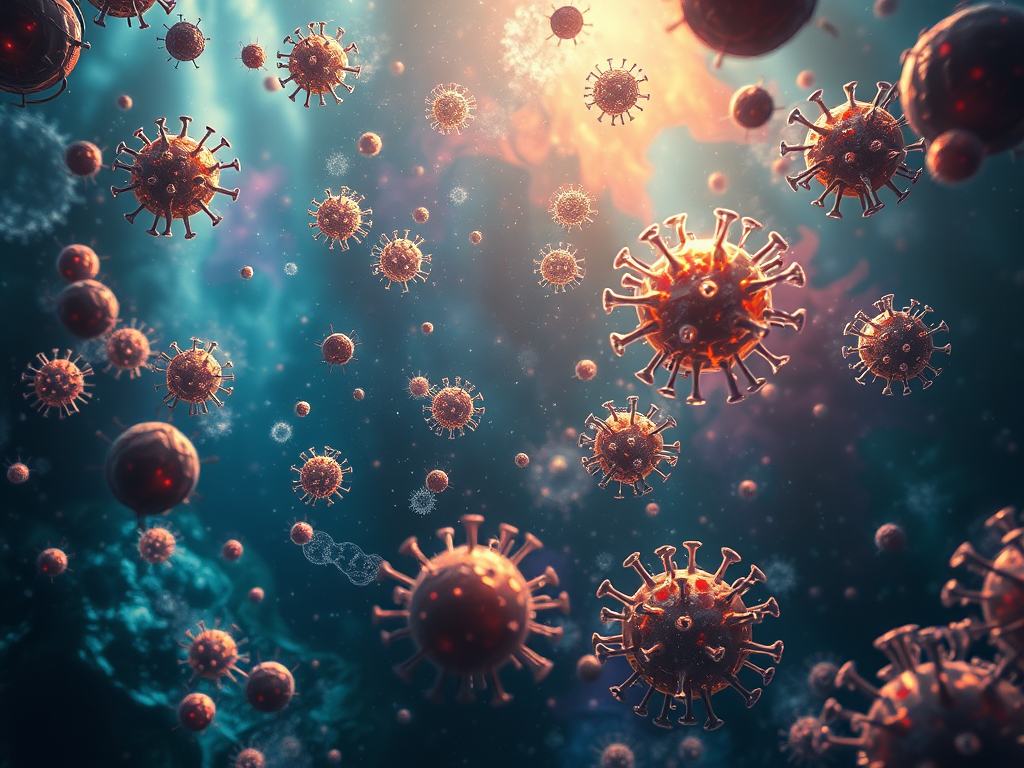
Event: The Rise of Viruses
Date: ~3.5–3.0 billion years ago | ~1,000–1,500 million years after Earth’s formation
“Viruses are the edge of life, shimmering between chemistry and intention.”
— François Jacob
Dear Human,
They came like echoes from a forgotten age — fragments of thought that refused to die. In the restless seas where life multiplied, tiny strands of code drifted between the living and the lifeless, carrying no breath, no hunger, no will. They were not creatures, but contagions — shards of instruction seeking a host to remember them.
Some were born of broken cells, cast loose when their makers perished. Others were older still, relics from the dawn of replication itself — ghosts of an ancient language once spoken by RNA alone. They wandered the dark oceans like whispers without mouths, waiting for something warm to touch, something alive to deceive.
When they found it, they awoke.
A single particle drifted close to a living cell, drawn by chance, by charge, by the faint recognition written in shape. Its protein shell brushed against the cell’s membrane — a perfect fit, as if made for the lock it was about to break. Hooks and spikes anchored it in place. Then, with a subtle twist of chemistry, the shell opened, and the code within — a thread of RNA or DNA — slipped through the living wall.
Inside, the intruder was blind but precise. Its strand uncoiled like a command. The cell, unable to tell the difference between foreign and familiar, began to obey. Ribosomes read the invader’s message and produced viral proteins instead of their own. The factory of life was seized from within — its engines still turning, its power still flowing, but now in service to something that could not live without it.
New copies of the viral genome were printed by the host’s own enzymes, each coiling itself into a ghost of the original. The fresh strands were wrapped in newly made protein shells, assembling like soldiers in perfect order. The cell’s resources drained away — lipids, sugars, nucleotides — all converted into the material of replication. Energy that once sustained now fueled invasion.
When the work was complete, the cell itself became the weapon. Viral enzymes ruptured its membrane, tearing apart the boundary that defined it. In an instant, the contents spilled outward — a thousand identical particles rushing into the sea to seek new hosts. Where there had been life, there was only release. The body that had built them was gone, but its machinery lived on in every new infection.
Life had created its own reapers — its own method of self-dismantling and self-renewal.
These were the first viruses — neither living nor dead, existing only in the tension between. They were hunger without a mouth, intention without awareness. Too fragile to survive alone, yet too persistent to vanish. They spread like prophecy, feeding not on matter but on motion — the ability of the living to build.
Their invasions carved a new pattern into existence.
Each host that fell became a teacher. Each infection rewrote the script of life. In their endless exchange, genes began to mingle — pieces of one creature stitched into another. The world learned from its tormentors. Evolution quickened, no longer crawling but leaping, driven by the thefts of these molecular thieves.
For every life they ended, they gave rise to a thousand new possibilities.
They became both destroyer and author, the dark twin of creation. And as the ages passed, their remnants embedded themselves within the very code they once consumed. They became part of the story they had once interrupted.
Even now, they remain — not above us, but within us. Half of the human genome is written from their fragments, silent echoes of ancient infections. Some stir to shape our beginnings, others guard our cells from newer invaders. The monsters of the first world became architects of the next.
In their reflection, life sees its own truth — that survival is not purity, but adaptation. Creation borrows from destruction. Memory feeds on loss. Even our blood carries their language, their persistence, their unending hunger to remain.
They were never truly alive, yet through them, life learned what endurance meant.
The edge they inhabit is the same we walk still — between decay and renewal, between silence and song.
Pathfinder
 Project Pathfinder
Leave a comment