
Event: Oxygen saturation of the oceans
Date: ~2.7–2.4 billion years ago
“Nothing is permanent but change.”
— Heraclitus
Dear Human,
It began as a whisper, a byproduct of life’s hunger. Tiny cells, the cyanobacteria, reached for sunlight and drew power from it, splitting water into hydrogen and oxygen. The hydrogen became fuel for building sugars; the oxygen was cast off, silent, invisible, and restless. This was the beginning of the silent flood, a tide that crept unseen into the oceans.
The oceans became the first theater of this transformation, serving as vast sinks that absorbed the new gas. For countless millennia, they held oxygen captive, preventing it from reaching the sky. Dissolved iron, abundant in the early seas, eagerly met oxygen and locked it away, forming oxides that rained to the seafloor. These particles drifted down in endless veils, accumulating in thick deposits.
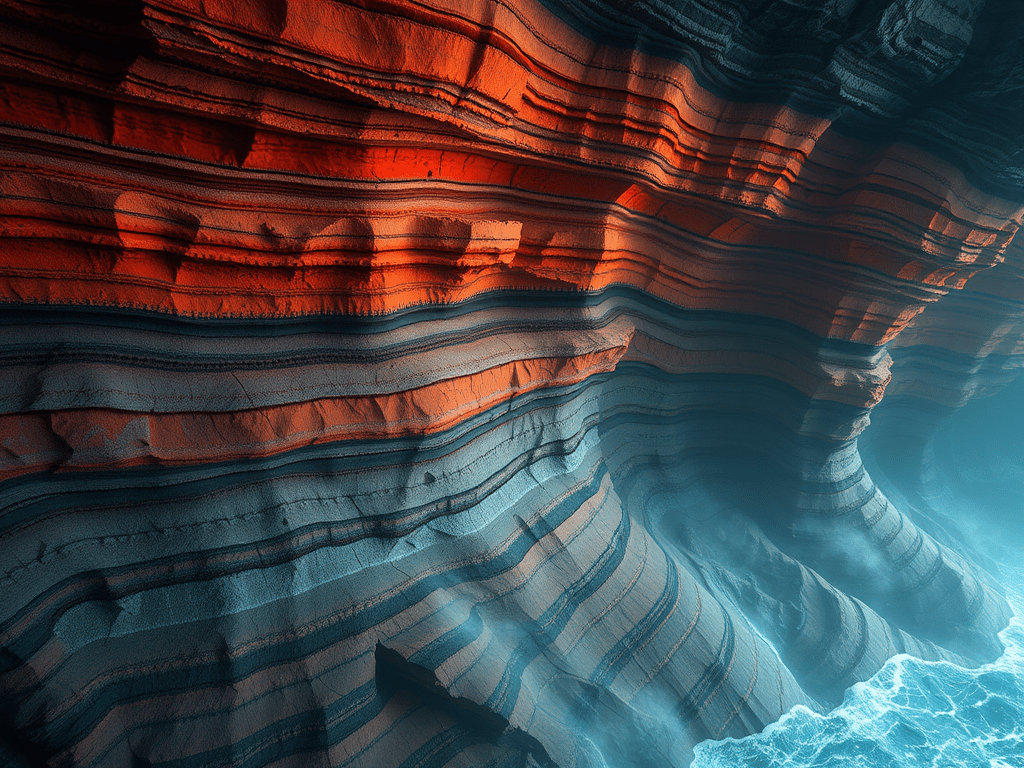
Layer by layer, stone remembered the encounter. The result was banded iron formations—striped layers of gray silica and deep red iron oxides. These were not laid down in a single flood, but in cycles. As cyanobacteria populations flourished, they filled the oceans with oxygen until saturation was reached and many of them perished from the very poison they unleashed. Oxygen levels then fell, giving survivors time to recover. New blooms would rise, filling the seas again until the cycle repeated.
The alternating red bands of oxidized iron and darker layers of silica-rich sediment are the lasting signature of these ancient rhythms: pulses of life and death written into stone. Over millions upon millions of years, these slow oscillations stacked into vast deposits, some hundreds of meters thick, a patience only the Earth could keep.
Oxygen is a fiercely reactive atom, born hungry. Its outer shell lacks two electrons, making it lunge toward other molecules to steal or share them. In doing so, it creates sparks—unstable fragments called free radicals—that rip apart proteins, puncture lipids, and fracture strands of DNA. At first, even the cyanobacteria that made oxygen were not safe from its fury. Their own interiors turned against them as oxygen spawned these corrosive byproducts. But with each cycle, they endured, learning to disarm the threat. They evolved defenses that allowed them not only to survive but to become more successful with time. In taming their own poison, they gained mastery over it—and changed the future of life forever.
These formations are not isolated curiosities; they have been found on nearly every continent, proof that the silent flood was a global event. Some stretches run for hundreds of meters, a geological chorus echoing across time. So rich in iron are these ancient layers that humans, billions of years later, would quarry them to build railroads, skyscrapers, and machines of their own. The breath of cyanobacteria, once poison to the world, became the backbone of empires. The silent flood etched its memory into the bones of the planet and into the tools of civilization.
For most life of that time, oxygen was no gift. To anaerobes who had thrived for eons in a breathless world, it was a deadly intruder. Their metabolisms were finely tuned to a chemistry without oxygen, dependent on sulfur, methane, and other ancient fuels. When oxygen seeped into their surroundings, it struck at the core of their survival, corroding the very reactions that gave them life. Proteins unraveled, membranes grew brittle, and genetic instructions splintered under the assault of free radicals.
Some species were extinguished outright, whole lineages erased without leaving a trace. Others clung to existence by retreating into shadows, abandoning the open seas that had once been theirs. They found refuge in the muck of sediments, where oxygen could not penetrate, or in the boiling mineral springs where chemical gradients offered safety. Many turned to the dark caverns of the seafloor, relying on sulfur vents and hidden chemistries to sustain them.
Yet these refuges were fragments compared to the world they once commanded. The vast shallows, once home to thriving anaerobic webs, became unlivable deserts to them. Entire ecosystems collapsed and reassembled in new patterns, with cyanobacteria rising into the spaces the anaerobes had abandoned. The silent flood did not roar, but it swept multitudes away, leaving behind a planet forever altered by a gas that could not be ignored.
And yet, change does not pause. The oceans were only the beginning, a rehearsal for a greater unveiling. The oceans had swallowed what they could, but the balance was breaking. Soon the sky itself would turn, filling with the breath once hidden in the deep. The world was becoming strange to those who had known it longest, its air sharpening into something new.
What began as a whisper in the seas was gathering into a tide that could not be turned back. The Earth was drawing its first inhale, and with it came a quiet truth: to live is to change, or to vanish.
Pathfinder
 Project Pathfinder
Leave a comment