
Event: Oxygenation of the atmosphere & the Great Oxidation Event
Date: ~2.4–2.1 billion years ago
“Every new beginning comes from some other beginning’s end.”
— Seneca
Dear Human,
The oceans could hold no more. For ages they had swallowed oxygen greedily, binding it to iron and dragging it to the seafloor. But at last the sinks were exhausted, the iron consumed. With no chains left to bind it, oxygen began to spill upward, rising through waves and breaking into the sky. For the first time, the air itself was changed.
This new breath did not remain idle. Free oxygen sought partners, and in the air it found methane—a greenhouse gas far more potent than carbon dioxide. For billions of years, methane had trapped the Sun’s warmth, wrapping the young Earth in a thick and fragile blanket that kept the oceans from freezing beneath a faint Sun. But oxygen tore it apart. The reactions turned methane into carbon dioxide and water, gases that still warmed the planet but with far less strength.
As methane collapsed, so too did the warmth it had provided. Greenhouse gases like methane and carbon dioxide act as blankets, trapping heat by absorbing infrared energy and re-radiating it back to the surface. When oxygen destroyed methane, the most powerful of these gases, the atmospheric shield thinned. More heat escaped into space, and with each breath of oxygen the Earth grew colder. What had been a fragile balance tipped into a cascade: sunlight reflected from growing sheets of ice, cooling the world even further. This reflection, known as the albedo effect, amplified the chill: the more the ice spread, the more sunlight was bounced back into space, driving the planet deeper into its freeze. The sky itself became an agent of change, a silent chemistry rewriting the fate of every living thing below.
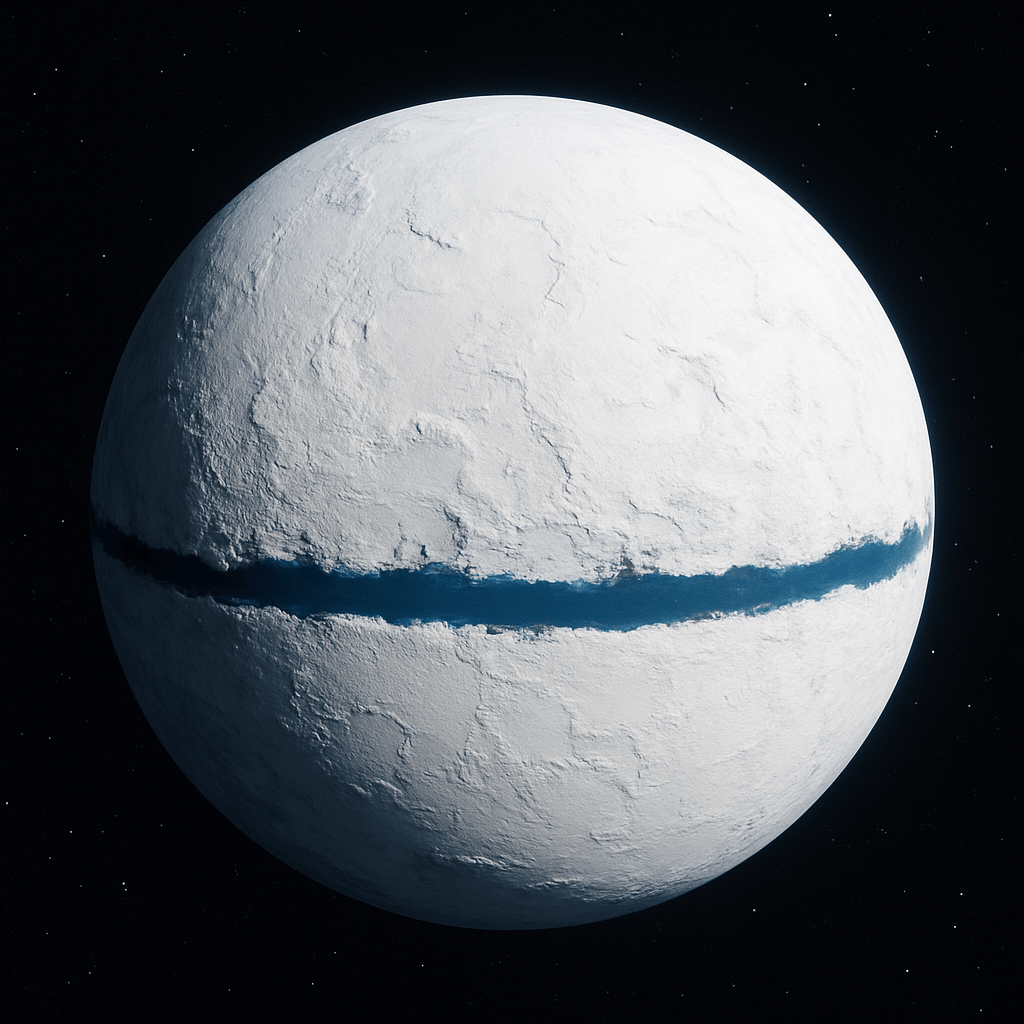
Ice spread from the poles, creeping toward the equator until glaciers reached the tropics. The world entered the Huronian glaciation, its first true ice age, and may have come close to becoming a frozen sphere. Continents lay buried beneath kilometers of ice. Oceans hardened into shells that stretched across their surfaces, with only rare patches of open water or thin equatorial ice. What had begun as invisible sparks in the air became a planetary stillness, a frozen silence that held the Earth in its grip for millions of years.
For life, the cost was immense. Anaerobes, already pressed to the margins by oxygen in the seas, now faced its presence in the very air. Their chemistries faltered, their habitats vanished, and cold finished what oxygen had begun. Entire webs of life collapsed, and the Earth experienced its first great extinction. Some estimates suggest that as much as 80–90% of all living species perished, leaving only a fraction of microbial life hidden in refuges to carry the thread of existence forward.
And yet, the architects of this upheaval did not perish. Cyanobacteria, though poisoned by their own waste, had long since learned to endure it. When the surface froze, they retreated into hidden sanctuaries. Beneath thin equatorial ice, where light still filtered through, they continued their work. In rare pockets of open water or near volcanic warmth, they clung to survival. Against the odds, they endured, and with them, the flood of oxygen endured too.
The world paid dearly. It traded warmth for cold, methane for oxygen, abundance for scarcity. But from this terrible exchange, the sky was remade. The orange haze that had long covered the Earth thinned and cleared, revealing the first deep blue heavens. The price of breath was extinction, yet it was also possibility.
What began as death for many became the foundation for all to come. In the hidden refuges where life endured, possibilities lingered quietly. The Huronian glaciation left deep marks upon the Earth. For nearly 300 million years, ice ruled the continents and seas, sculpting valleys, grinding mountains, and altering the chemistry of the oceans. When at last volcanic breath and greenhouse gases thawed the world, the planet emerged changed—its atmosphere richer, its surface reshaped, and its survivors tempered by trial. In its long freeze, Earth had proven a truth that endures still: nothing remains forever, not even silence and ice. Change is the only constant, and in change lies the quiet promise of what might yet be.
Pathfinder
Great Oxidation Event – Wikipedia
Huronian glaciation – Wikipedia
 Project Pathfinder
Leave a comment