
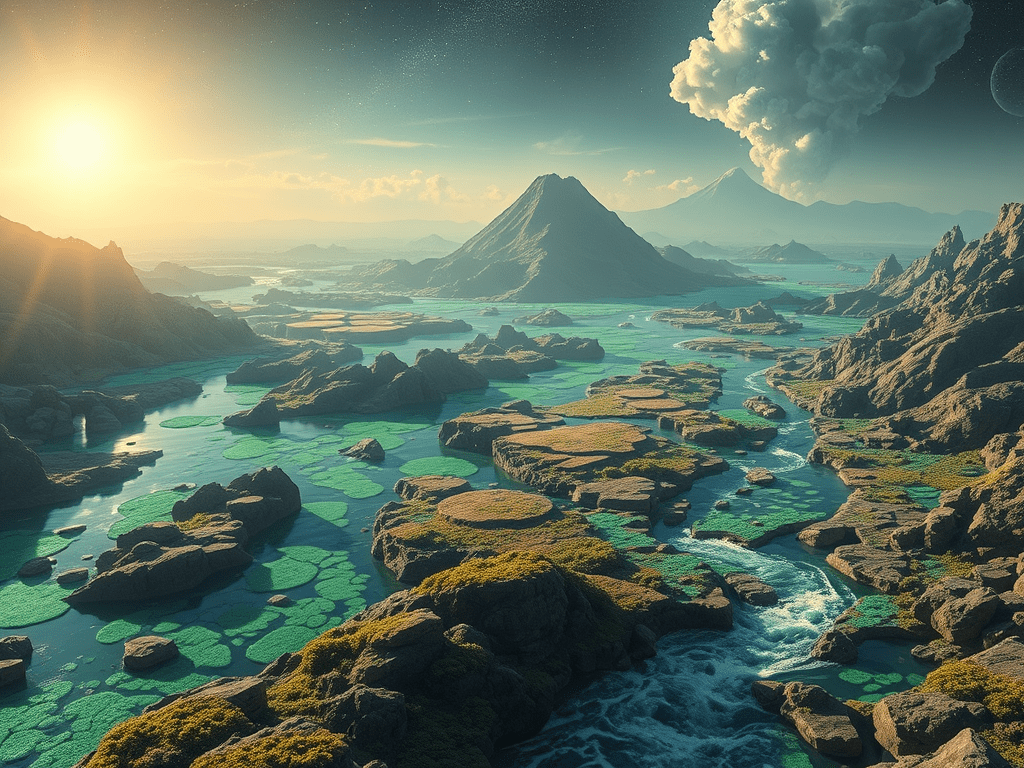
Event: Stabilization of Earth’s Biosphere after the Huronian Glaciation
Date: ~2.1 billion years ago | ~2,500 million years after Earth’s formation
“Balance is not the absence of change, but its rhythm.”
— Gregory Bateson
Dear Human,
When the glaciers at last began to fade, the Earth exhaled. The weight of ice that had held it silent for eons melted back into the sea. Rivers carved new paths through exposed stone, carrying ground dust and minerals into waiting oceans. Mist rose from thawing plains, and sunlight — pale but steady — poured across the world’s surface for the first time in ages.
The silence of the frozen age gave way to motion. Cyanobacteria, long trapped beneath the ice, spread once more across the shallows. Their blooms turned the waters shades of jade and copper, releasing oxygen into the warming air. Volcanoes rumbled beneath the thaw, exhaling carbon dioxide that fed both climate and life. With every breath of the Earth came a response from the living, a balance of opposites — gas to sea, sea to sky, sky to life.
The carbon and oxygen cycles found their rhythm in this exchange. Rain washed carbon from the atmosphere, and rivers carried it into the sea, where it settled as limestone and shell. The air cooled as the land grew greener. Volcanoes reheated what the storms had softened, and in this slow alternation, the planet found its equilibrium. The sky deepened to a bluer hue as oxygen built up, scattering sunlight into brightness. The seas, once rust-red with dissolved iron, cleared to a deep green-blue, rich with algae and promise.
In these waters, eukaryotic cells flourished — larger, stronger, and more intricate than any life that had come before. Their mitochondria burned oxygen for energy, while others, newly equipped with chloroplasts, turned sunlight into food. They multiplied and mingled, forming webs of exchange in the sea. Some began to cluster together after dividing, sharing tasks and survival — small colonies foreshadowing the first bodies.
The continents too began to awaken. Across their raw surfaces, thin films of microbes spread, their chemistry slowly breaking rock into soil. Lichens and biofilms exhaled acids that dissolved minerals, sending nutrients into the waters below. This biological weathering tethered land and ocean into one breathing system — the crust of the Earth now part of life’s own metabolism.
Over time, the air grew richer, the seas more fertile, the cycles more stable. Each breath of oxygen strengthened the pulse of life, and each death returned carbon to the deep, closing the circle. The biosphere had become self-sustaining — a web of feedback, resilience, and renewal.
And so the long dawn rose across the planet. It was not sudden or bright, but steady — a widening light that reached into every corner of sea and sky. The ice was gone. The air carried warmth. The waters shimmered with new color and sound. Beneath that patient glow, life expanded quietly, weaving itself into a tapestry that would one day bloom into forests, creatures, and thought.
The age of survival had ended. The age of preparation had arrived.
Pathfinder
 Project Pathfinder
Leave a comment