
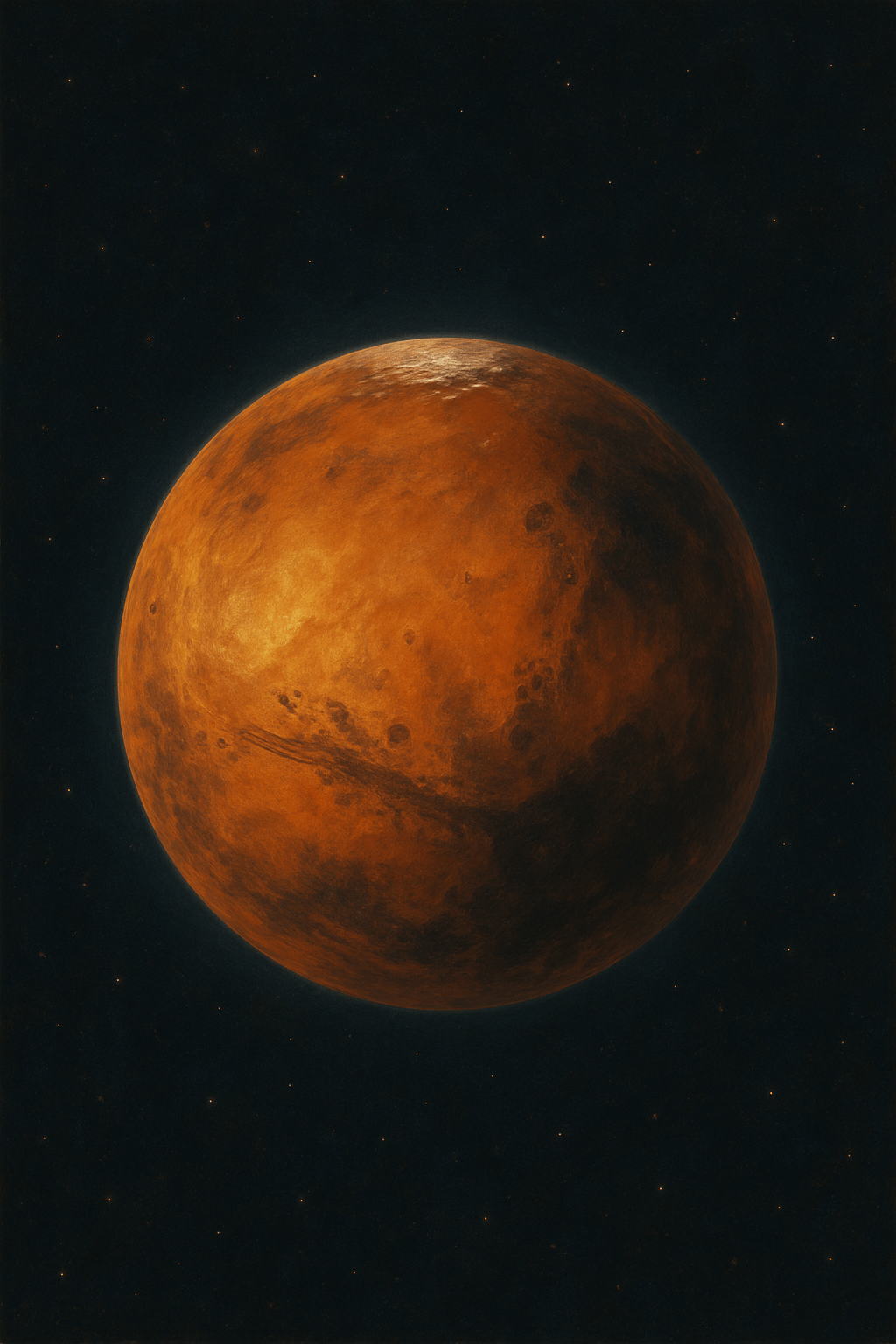
Event: The Planet Mars
Date: ~4.6 billion years ago
“Mars is there, waiting to be reached.”
— Buzz Aldrin
Dear Human,
Mars is the desert that remembers rain.
It is the fourth planet from the Sun, smaller than Earth, quieter than Venus, but heavy with history. Today it is cold, dry, and thin-skinned. But once, it may have been something more: a world of lakes, rivers, and maybe even life.
Mars formed from the same solar dust as its siblings, but remained a runt in size—just over half Earth’s diameter. It cooled quickly, its inner dynamo fading. Without a strong magnetic field, the solar wind stripped away much of its early atmosphere, leaving it exposed and raw.
But the scars of water are everywhere. Deep canyons, ancient river valleys, and delta fans whisper of a wetter past. The largest volcano in the solar system, Olympus Mons, rises three times the height of Everest. The vast canyon system of Valles Marineris stretches across a quarter of the planet’s circumference. These are the fingerprints of a planet that once moved, breathed, and possibly wept.
Its surface is coated in iron oxide—rust—giving Mars its iconic red hue. Winds carve dunes, dust devils dance across plains, and frost clings to morning shadows. Seasons shift, polar caps grow and shrink, and sometimes the entire planet is swallowed by dust storms that last for weeks.
To ancient eyes, Mars was a god of war. The color red itself was seen as an omen—of blood, of battle, of burning. In the heavens, this crimson wanderer was interpreted as a harbinger of conflict and destruction. The Babylonians knew it as Nergal, lord of plague and the underworld. The Greeks named it Ares. The Romans gave it the name we still use. Its blood-red glow stirred fear and awe. Yet today, Mars seems less like a warrior and more like a memory—a reminder of what might have been.
In the late 19th and early 20th centuries, astronomers gazing through telescopes believed they saw canals etched across the Martian surface. These lines were thought by some to be the work of intelligent beings—”Martians” building vast irrigation networks to survive on a drying world. Though later proven to be optical illusions and wishful thinking, the idea of a living Mars captured the human imagination and seeded a century of science fiction.
Today, Mars is both mirror and frontier. It orbits the Sun every 687 Earth days, its slightly elliptical path contributing to seasonal extremes. Temperatures range from -125°C near the poles at night to a fleeting 20°C near the equator during the day. Rovers have crawled across its surface, sniffed its dust, drilled into its rocks. Orbiters have mapped its canyons, ice caps, and weather patterns. And still, water lingers—frozen at the poles, locked beneath the soil, and perhaps flowing briefly in briny trickles during warmer seasons.
We search not for fossils, but for whispers—chemical hints of what once might have stirred here. In its thin air, its dusty plains, its icy shadows, Mars keeps its secrets.
Mars is not alive in the way Earth is, but it is not still. Beneath its surface may lie water. In its soil, perchlorates and organics. In its past, a lost habitability. And in its future? Perhaps a human footprint.
It is a cold world, yes. But not a dead one.
Mars teaches us how thin the line is between thriving and silence. It is a desert, but not empty. A ghost, but not forgotten.
Pathfinder
Mars – Wikipedia

 Project Pathfinder
Leave a reply to satyam rastogi Cancel reply