
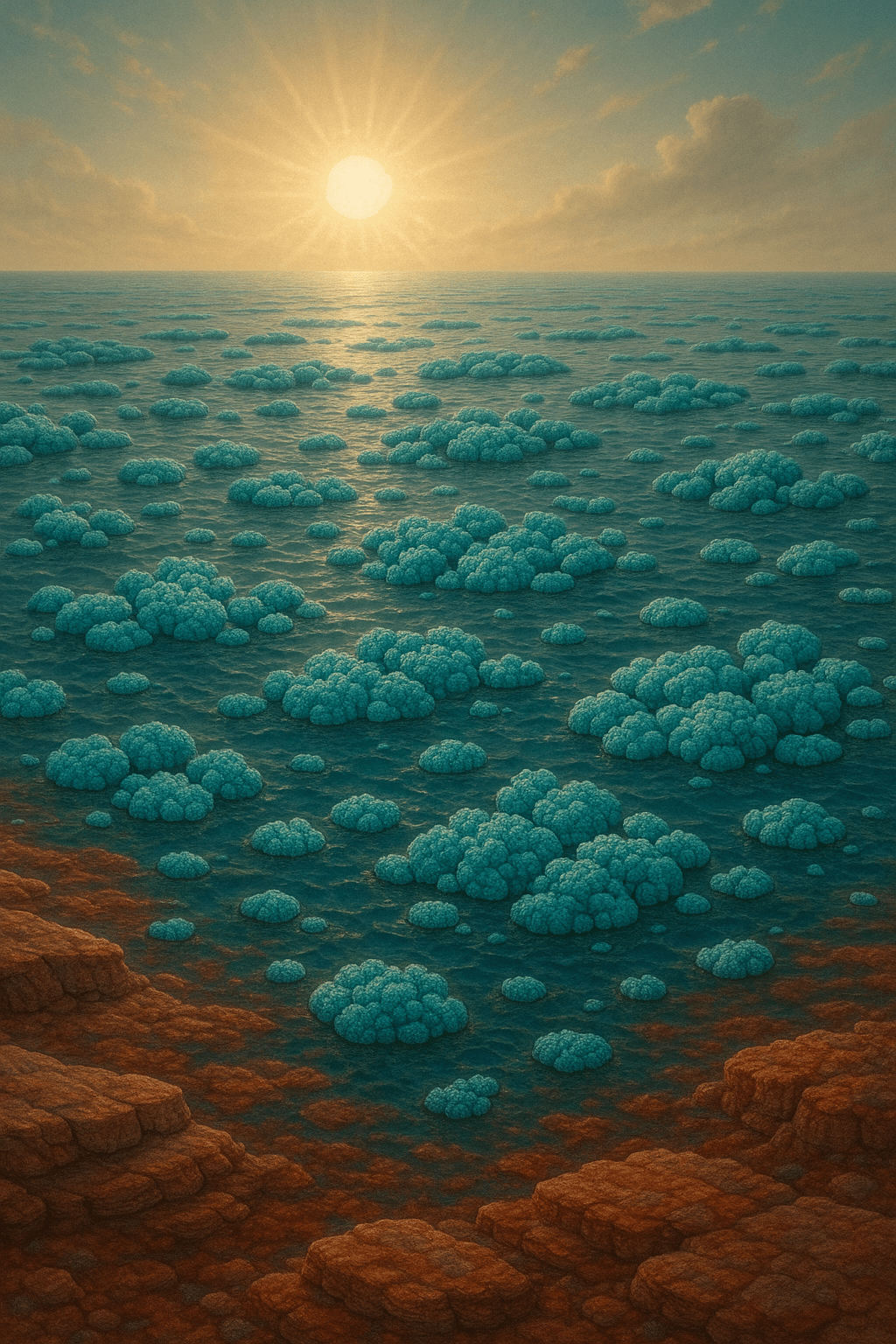
Event: Evolution of Photosynthesis by Cyanobacteria
Date: ~2.9 to 2.3 billion years ago
“Early in the earth’s history, cyanobacteria also generated the planet’s first oxygen atmosphere, making the world livable.”
-James Rollins
Dear Human,
Long before your forests and fields, before animals breathed the air, life found its way in darkness. The earliest cells clung to vents and mineral seeps, taking what little energy they could from the chemistry of stone and fire. Sulfur, iron, and hydrogen were the fuels of those hidden worlds, fragile economies of survival bound to narrow places where the Earth leaked its heat.
Then, a quiet but world-shaping change unfolded. A group of small blue-green cells — cyanobacteria — discovered a new way to live. They learned to use pigments, chlorophyll-like molecules that captured photons falling from the Sun. With this gift, they could turn light itself into energy. They split molecules of water, pulling out electrons to drive their chemistry, and combined these with carbon dioxide from the air and oceans. Out of this alchemy, they built sugars — simple stores of chemical energy — the foundation for growth and survival. The reaction produced an unexpected waste: oxygen. To the ancient anaerobic world, oxygen was a toxin, corrosive and strange. To you, it is breath, flame, and possibility.
This invention was more than survival. It was abundance. Before, life had been chained to rare and hidden oases — the chemical smoke of vents, the trickle of mineral springs, the cracks where Earth bled. But sunlight was everywhere. Now, for the first time, life was free to move out of the shadows. Cyanobacteria could spread wherever light touched water, coating tidal flats, drifting in open seas, stretching across shallow lagoons. They turned whole oceans into engines of energy, no longer trapped in isolated pockets but woven into a global web. Their colonies layered into stromatolites — stony mounds that still stand as the fossils of freedom, monuments to the first time life reached beyond its confines and claimed the open world.
At first, the oxygen they made did not rise into the sky. The oceans drank it in. It bonded with dissolved iron, falling as rust-colored sediments, painting the seafloors in bands of red rock that endure as ancient archives — the Banded Iron Formations. Only after the seas’ metals were exhausted did oxygen begin to linger, creeping into the atmosphere drop by drop, slowly shifting the balance of the planet.
Energy now moved differently across Earth. What had once been fragile sparks of chemistry became a flood of sunlight transformed into food. Entire ecosystems thickened, not only in size but in stability. Where before life ebbed and flowed with the fortune of minerals, now it pulsed with the certainty of the rising Sun. No vent, no spring, no crack in stone could match its constancy. For the first time, survival did not hinge on chance, but on a rhythm that never faltered — day after day, light returned. The Sun became the anchor of life’s memory, and its promise shaped every breath that followed.
With every pulse of photosynthesis, the planet was quietly remade. Oxygen seeped into the oceans, stone was rusted into red rock, and the atmosphere began to shift toward a future none of that first life could imagine. It was the slow dawn of a breathable world, a revolution of light and freedom that still carries you in every breath.
The solar revolution had begun, and Earth would never be the same.
Pathfinder
Photosynthesis – Wikipedia
 Project Pathfinder
Leave a comment